Recent Books and Articles
Wealth With Intention: Aligning Family Wealth with Values, for Families and their Advisors
Read this short thought piece titled Wealth With Intention: Aligning Family Wealth with Values, for Families and their Advisors, published in Talking Trends online magazine on July 7, 2026; also check out this brief video clip.
Wealth With Intention: Aligning Family Wealth with Values, for Families and their Advisors
Last updated: July 7, 2026
Quick Answer
Wealth with intention is the concept of aligning a family’s financial decisions, governance, investing, philanthropy, and public presence, with its clearly articulated set of shared values, rather than measuring success only by external markers like career achievement or investment performance.
For families, it starts with a facilitated process to surface individual and shared values and codify them into a usable framework.
For professional advisors, it provides the values-based foundation on which governance, philanthropic, and succession planning should be built, rather than treated as a separate conversation from the financial one.
What “Wealth With Intention” Means
Wealth is typically discussed in terms of assets, structures, and strategies. Families who thrive across generations, and who preserve legacy and identity alongside capital, tend to approach wealth differently. Rather than measuring only external markers, career achievements, philanthropic gifts, investment performance, they use wealth as a tool for living with purpose.
At its core, wealth with intention begins with a deceptively simple question: What are our family’s values? For families of significant wealth, this isn’t a philosophical exercise. It’s the foundation of long-term cohesiveness, clarity, and impact, and it’s the question that should precede, not follow, governance and estate planning.
Step One: Defining Who You Are, Individually and Collectively
Every family has a story, but not every family has articulated it thoughtfully. Wealth with intention requires deliberately exploring identity at two levels: who am I as an individual, and who are we as a family?
In practice, this generally involves a facilitated process, incorporating structured conversations, individual interviews with family members, and guided reflection, designed to surface individual and shared values. The goal is to distill divergent views into a concise, shared set of principles (integrity, stewardship, service, learning, humility, excellence, generosity are common examples), without requiring unanimity on every point.
This process typically clarifies four distinct beliefs:
- Personal identity: the values that guide each individual family member’s decisions and behavior.
- Family identity: the shared principles that bind generations and family branches together.
- Internal culture: the expectations, norms, and traditions that shape daily family life.
- External presence: how the family wants to be perceived, whether through public visibility or quiet influence. Some families want their name on a building; others prefer to contribute discreetly. Both are valid choices, what matters is that the choice is intentional rather than default.
These values become the benchmark against which every governance, investment, philanthropy, and public-presence decision is measured going forward.
Step Two: Codifying Values into a Usable Framework
Values function as the connective tissue of a family’s legacy. They answer the questions behind the wealth: why do we have these resources, and why were we given these opportunities?
When families take the time to identify shared values, they typically discover the common threads that unite them across branches, generations, and life stages, threads that aren’t visible when the conversation stays focused on assets alone.
Identifying values, however, is only the first step. The next is codification: turning abstract ideas into practical commitments. This can take the form of a family vision, mission, or values statement; a set of governance bylaws; or a full family constitution.
The specific document format matters less than the underlying process, clearly defining roles, responsibilities, and decision rights across generations, and ensuring investment, philanthropic, and governance decisions actually align with what the family says it stands for. The process itself is the real deliverable.
Step Three: Living Intentionally in a World of Abundance
For families with significant resources, the range of available options is nearly unlimited. That abundance can empower a family or overwhelm it. Wealth with intention functions as a filter, helping a family choose opportunities that align with its identity and decline those that don’t.
In practice, intentional living means:
- Using wealth to reinforce personal and collective character, not just fund lifestyle;
- Making decisions based on long-term purpose rather than short-term convenience;
- Treating privilege as a platform for contribution rather than a source of complacency;
- Teaching rising generations not just how to manage wealth, but how to steward it; and
- Using consistent language across family communications that reinforces both internal identity and external presence.
Families of wealth frequently express a desire to “make the world a better place.” Wealth with intention converts that aspiration into a concrete framework for action, deploying financial, social, intellectual, and emotional capital deliberately rather than reactively. Privilege, in this framing, isn’t something to hide or apologize for; it’s something to use wisely, thoughtfully, and generously.
Why This Matters for Professional Advisors
For attorneys, CPAs, and wealth managers, “wealth with intention” isn’t a soft add-on to technical planning, it’s the values framework that governance, estate, and philanthropic structures should be built to serve. A family constitution or philanthropic mission statement drafted without first surfacing the family’s actual shared values tends to produce documents that look good on paper but don’t hold up under real family pressure. Advisors who help clients do the values work first, then align governance and planning documents to it, produce more durable outcomes than those who treat structure and identity as separate workstreams.
Key Takeaways
- Wealth with intention means measuring success by alignment with values, not only by external financial or philanthropic markers.
- The process starts with surfacing personal and family identity across four layers: personal identity, family identity, internal culture, and external presence.
- Codification through a mission statement, values statement, bylaws, or family constitution, turns identified values into a usable decision-making framework.
- Intentional families use abundance as a filter for decision-making, not an open field of unlimited options.
- For advisors, values work should precede, not follow, governance and succession planning, since documents built on unarticulated values rarely hold up under family pressure.
Wealth Legacy Advisors LLC works with multigenerational families, family offices, and family-owned businesses on governance, family meeting facilitation, and succession planning. Learn more about our approach at WLALLC.com.
Susan Schoenfeld, a public speaker & thought partner to families of wealth and their advisors, is an award-winning thought leader and family wealth counselor. Susan’s transition from a successful estate planning attorney and CPA to a trusted family advisor and thought partner was sparked by the deeper, more probing questions she received from wealthy families, questions that went far beyond traditional estate tax planning. As a conflict-free advisor who provides no investment, tax, or legal advice, and sells no product, Susan offers unfiltered, actionable insights directly to high-net-worth families and financial professionals alike. Her expertise and thought leadership have made her a sought-after keynote speaker at prestigious conferences across the United States and a leading facilitator to families of wealth.
5 Family Philanthropy Lessons from Susan Schoenfeld
The Community Foundation for Southeast Michigan in partnership with Planned Giving Roundtable of Southeast Michigan invited me to Bloomfield Hills, MI for a half-day conversation with donors, professional advisors, and nonprofit partners about the human side of wealth on June 11, 2026.
They excerpted my remarks into this article, published on June 22, 2026: 5 Family Philanthropy Lessons from Susan Schoenfeld.
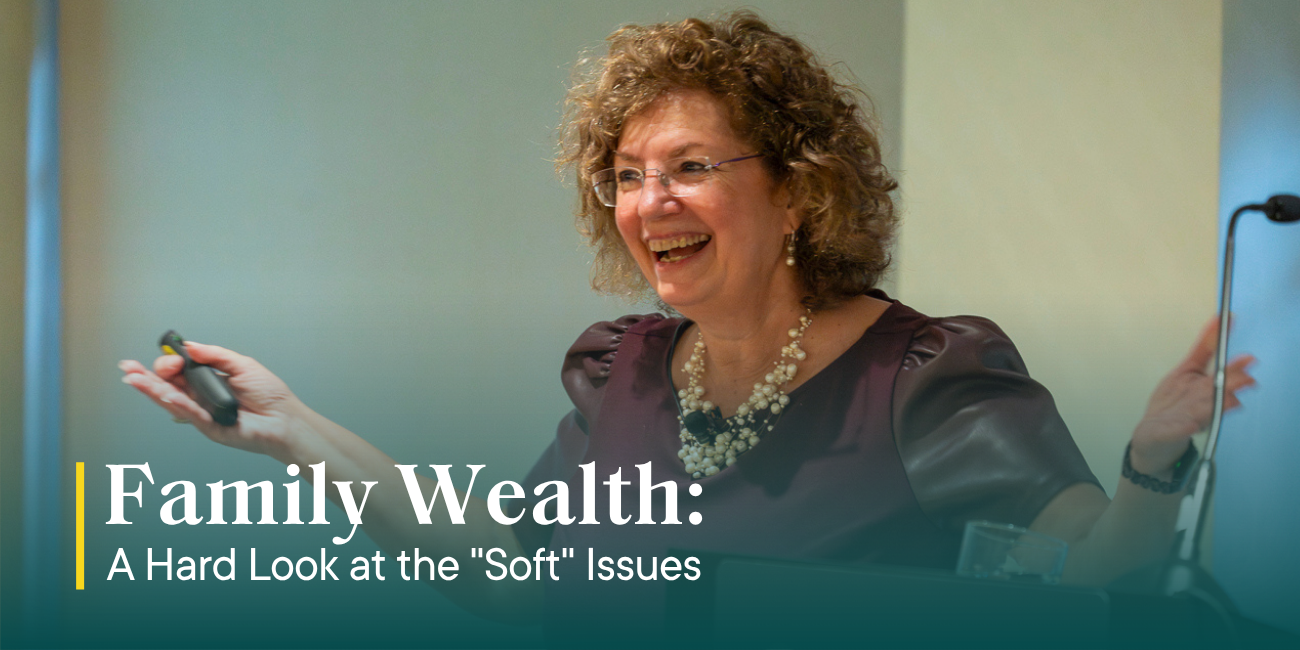
5 Family Philanthropy Lessons from Susan Schoenfeld

The hardest questions in family wealth aren’t financial — they’re human. How much do you tell your children about the family’s wealth, and when? How do you raise kids who are grounded rather than entitled? What does it mean to pass on values alongside assets?
These are the questions Susan Schoenfeld has spent her career addressing. As CEO and founder of Wealth Legacy Advisors LLC, she works with families of wealth and the advisors who serve them on what she calls the real issues of wealth — the ones that don’t show up on any balance sheet, but that quietly determine whether a family’s legacy holds together across generations.
In June 2026, the Community Foundation for Southeast Michigan in partnership with Planned Giving Roundtable of Southeast Michigan brought Schoenfeld to Bloomfield Hills for “Family Wealth: A Hard Look at the “Soft” Issues” — a half-day conversation with donors, professional advisors, and nonprofit partners about the human side of wealth.
What follows are five of the most resonant lessons from that morning.
Lesson 1: The hardest questions in family wealth aren’t financial — they’re human.
Most advisors lead with investment performance, tax strategies, and legal structures. Those things matter. But they aren’t what keeps families of wealth up at night. What actually keeps families up at night is the human side: how much to tell the kids, how to raise children who are grounded rather than entitled, and how to make sure wealth becomes a source of purpose rather than division.
Susan Schoenfeld has spent her career arguing that these so-called “soft issues” are, in fact, the hardest ones families face — and the ones most likely to determine whether a family’s legacy holds together across generations.
Lesson 2: Wealth is Already the Elephant in the Room
Children see how you live. They Google you, they Zillow your house, and if you have a private foundation, they can find your giving history on GuideStar. Pretending the wealth doesn’t exist isn’t protecting them — it’s leaving them unequipped for conversations that are coming regardless.
Schoenfeld’s advice: don’t fudge. It’s okay to tell a child that something is private rather than secret, and that you’ll talk about it at home — as long as you actually do. The money talk may be uncomfortable, but the cost of never having it is far greater.
Lesson 3: The single best thing you can do for your children is make them work.
Across hundreds of families, the most consistent answer to “how did you raise non-entitled kids?” was this: require after-school jobs and summer jobs, in companies outside the family business. Earning your own paycheck — and watching withholding taxes take a piece of it — creates a relationship to money that simply can’t be replicated by being handed funds.
It builds financial literacy, teaches the difference between wants and needs, and perhaps most importantly, builds empathy for the people who will one day work alongside or for your children. For younger children, the three-jar allowance system (spend, save, give) and matching contributions to the give jar offer an early, tangible introduction to the same principles.
Lesson 4: Family governance isn’t about documents — it’s about stories.
The will, the trust, the foundation documents — those are the scaffolding. The real work of family governance is answering a more fundamental question: who are we, and what do we want to pass on? Schoenfeld walked through the who, what, when, where, and how of family meetings, with one clear throughline: the families that navigate wealth well are the ones who have articulated their values before the disagreements arise, not after.
That might mean a formal family constitution, a shared mission statement, or simply a set of stories told and retold across generations. It also means being thoughtful about who is in the room — including spouses, who are the parents of your grandchildren, and whose buy-in to your family’s values matters more than most people realize.
Lesson 5: Silence is the most expensive estate planning mistake you can make.
Schoenfeld shared a story from her own family: her grandmother left everything to one daughter and nothing to the other — for entirely understandable reasons that were never communicated. The daughter who received nothing experienced it as proof she wasn’t loved. The sisters estranged. The assets eventually passed to a distant cousin, and the rift was never repaired. The lesson isn’t that parents can’t make different choices for different children. It’s that the silence around those choices does damage the explanation would have prevented.
Whether the conversation is about an unequal inheritance, a prenuptial agreement, or a philanthropy decision, the families that fare best are the ones who have it early, honestly, and in their own words — because bequests are a message from those who are no longer here. Make sure you leave the message you intend to.
Podcast Interview: Raising Stewards of Wealth – Family Business Audiocast with R. Adam Smith
I had a thoughtful conversation with R. Adam Smith on his Family Business Audiocast about Raising Stewards of Wealth, published on June 10, 2026.

How to Build Family Cohesiveness That Lasts
Click to read this short thought piece discussing How to Build Family Cohesiveness That Lasts, as published in Inspiration and Insights online magazine on June 2, 2026.
You can also watch this brief video clip.
How to Build Family Cohesiveness That Lasts
Regardless of their degree of wealth, success, or public recognition, families face a common challenge: staying connected in meaningful, enduring ways across generations. Not long ago, I worked with a large, highly visible family whose patriarch expressed this concern clearly. He said to me, “Your mandate is to restore harmony among my children.” That simple but powerful directive reflects a deeper truth: family cohesiveness does not happen by accident; it must be intentionally cultivated.
In my experience, the cornerstone of family cohesiveness is the deliberate and consistent creation of opportunities for communication and connection. Without these, even the strongest families can drift apart. Life gets busy, individual priorities take precedence, and over time, shared identity begins to erode. What’s required is a thoughtful approach that consistently brings people together, not just physically, but emotionally and relationally.
With this particular family, we implemented a solution that I often recommend: an annual family gathering or reunion designed with an eye to both purpose and flexibility. Importantly, the gathering was not solely focused on the family’s business, although it did include structured elements around shared responsibilities and long-term planning, and a session or two updating the family members about the family’s common investments. Equally essential were the fun, social elements: creating space for the informal, unplanned moments that allow family members to reconnect on a human level, and not just in their familiar family roles. These moments often prove to be the most transformative.
It’s important to pay close attention to creating environments where connections can happen organically, even among individuals who might not naturally gravitate toward one another. In many families, not every relationship is close, and that’s perfectly normal. However, by designing experiences that encourage interaction, shared meals, facilitated conversations, and collaborative activities, we were able to create new pathways for connection. Over time, these small interactions began to build familiarity and trust.
A critical component of this strategy was sustainability. I advised the patriarch to formalize his commitment by endowing the annual gathering. This meant creating a dedicated fund to ensure that, even after his passing, future generations would continue to come together. The fund was designed to cover travel expenses, meals, accommodations, activities, babysitting, and the cost of a professional facilitator. This removed logistical and financial barriers, making participation accessible and more likely for all.
Why is this so important? Because as families grow, they also become more complex. Siblings may share a common history, but even then, differences can create distance. As the family expands to include married-ins, cousins and subsequent generations, that shared narrative becomes increasingly diluted. Without intentional efforts to preserve connection, the sense of belonging can fragment.
This is why crafting and reinforcing a shared family story is so essential. Families need a narrative that binds them together, a sense of who they are, where they come from, and what they stand for. But storytelling alone is not enough. That narrative must be experienced and reinforced through regular interaction. Gathering together provides the space for those stories to be told, retold, and lived.
Equally important is the role of a neutral facilitator at family meetings. Siblings often fall into familiar patterns of negative behavior, what I sometimes refer to as “sandbox behavior,” where old dynamics resurface and productive communication breaks down. A skilled facilitator helps guide conversations, ensuring that all voices are heard and that discussions remain constructive. They create a safe environment where difficult topics can be addressed without escalating into conflict.
Ultimately, fostering family cohesiveness is not about eliminating differences; it is about creating a framework where differences can coexist within a foundation of mutual respect and understanding. It requires intention, structure, and a long-term commitment. But when done well, the rewards are profound: stronger relationships, a clearer sense of identity, and a legacy of connection that endures across generations.
Families that prioritize these efforts are not just preserving harmony in the present, they are investing in the resilience and unity of generations to come.
Family office succession planning
Susan wrote “Family office succession planning”, a chapter in the book: Essential Reads on Family Offices, published in December 2023 by Globe Law and Business Ltd.
Essential Reads on Family Offices is your essential resource featuring insights from the world’s foremost experts on the most pressing topics facing family offices and their advisers today, containing a collection of authoritative materials dedicated to providing family offices and their advisers with the most informative and thought-provoking contributions on key themes.
Fiduciary responsibility: the trustee role and its risks
Author of “Fiduciary responsibility: the trustee role and its risks”, a chapter in the book: Trusts in Prime Jurisdictions, Fifth Edition which was published in December 2019 by Globe Law and Business Ltd., Volume II pp 635-650.
The new edition, produced in association with STEP (The Society of Trust and Estate Practitioners), provides a solid grounding in the use of trusts in a wide range of important jurisdictions. Featuring chapters by leading professionals and recognised academics, the fifth edition of ‘Trusts in Prime Jurisdictions’ is an important handbook for all lawyers, trust practitioners and banking professionals working in the field.
Building Lasting Family Governance: Creating a Framework for Fair and Future-Proof Decision-Making
Read this short thought piece titled Building Lasting Family Governance: Creating a Framework for Fair and Future-Proof Decision-Making, published in Impact! online magazine on May 4, 2026, also check out this brief video clip.
Building Lasting Family Governance: Creating a Framework for Fair and Future-Proof Decision-Making
Governance is a critically important topic in any family enterprise. The word itself can sound complicated, but when you strip it down, governance is simply about one thing: how we make decisions together.
In family governance, the question becomes: How will we make decisions as a family? More importantly, how do we put a framework in place today, while everyone is getting along, that we agree will still guide us later when disagreements inevitably arise?
Because they will.
One of the most valuable things a family can do is establish a structure for decision-making today, while relationships are strong, communication is open and perspectives are collaborative. That’s the moment when people are most willing to create something fair and balanced, something that will work not just for now, but in the future as well.
I often compare this to what happens when two business partners go into business together and enter into a buy-sell agreement. When the partners create that agreement, they both recognize that someday one of them may well be the exiting partner, but they can’t predict which of them it will be, so they work together to design terms that feel fair for both sides. They are thinking ahead to a future moment when circumstances might change.
Family governance works in much the same way. You’re creating a framework today that everyone agrees will guide complicated decisions tomorrow, even during difficult or emotional periods.
In a family enterprise, governance can take several different forms. On the business side, it might include formal documents such as bylaws or an operating agreement that outline how the company will be run and by whom, how decisions will be made, and how compensation and other distributions will be determined.
On the family side, governance can look a little different. Many families begin with a mission, vision, and values statement, a shared articulation of what the family stands for and what principles will guide their decisions. Some families go further and develop family bylaws or even a family constitution, much like a country’s constitution. This provides a broad framework that defines expectations, responsibilities, and shared commitments.
The important thing is to start with the big picture first. Before getting into the detailed rules, begin with the broader questions:
- What do we stand for as a family?
- What are our guiding principles?
- What values do we want to carry forward into the next generation?
- What will hold us together when the chips are down?
These foundational ideas become the compass that guides more specific governance decisions later on.
Once those central principles are clear, you can move into the practical elements, the nuts and bolts of governance. That might include how family meetings are conducted, how leadership transitions are handled, how conflicts are resolved, and how major decisions about the business or family assets are made.
Another critical component of governance, one that families sometimes overlook, is involving the rising generation in the process.
If you want younger family members to engage with, respect and feel bound by a governance structure, they need to feel that they had some role in shaping it. That doesn’t mean they need full decision-making authority right away. They may not yet have a vote, and they may not have a veto, but they should have a voice.
Giving the rising generation a seat at the table helps them feel invested in the system you will be creating together. It also helps them to learn how the family enterprise works and how considered decision-making happens over time.
Some families formalize this by creating a Junior Advisory Council or Junior Advisory Board. This group of younger family members can meet, discuss issues, and offer recommendations to the main board or leadership group. It’s a way of building leadership skills and engagement long before the next generation steps into formal authority.
There’s an important psychological reason for doing this. People are far more likely to support a decision, even if it doesn’t ultimately go their way, when they feel that their voice was heard during the process. Being part of the conversation creates a sense of ownership and commitment.
That’s exactly what effective governance is designed to do. At its core, governance isn’t about rules for the sake of rules. It’s about creating a shared understanding of how, as a family, we will move forward together, how we will make decisions when challenges arise, and how we will preserve both the enterprise and the family relationships that support it.
When families take the time to build that framework thoughtfully, they create something incredibly valuable: a structure that can sustain them not only in the good times, but also when it seems there’s no common ground in sight.
The Real Inheritance: How Great Families Prepare Their Children for Leadership
Please read this short piece on The Real Inheritance: How Great Families Prepare Their Children for Leadership, as published in Point of View online magazine on April 7, 2026, also a short video clip.
The Real Inheritance: How Great Families Prepare Their Children for Leadership
Last updated: July 7, 2026
Preparing the next generation of wealth for leadership, whether in a family office, a family enterprise, or ultimately as stewards of the family itself, does not suddenly begin in adulthood. It starts much earlier. In fact, some of the most important foundations for responsible leadership can be laid when children are very young.
At the core of this preparation is financial literacy, but not in the traditional sense of spreadsheets and investment strategies. For young children, financial literacy begins with simple ideas: the difference between wants and needs, the concept of delayed gratification, and the importance of community. These early lessons build the framework for how the future leaders of your family will think about money, responsibility, and decision-making.
One of the most powerful lessons in raising children in a wealthy family is also one of the most delicate: helping them appreciate the privilege they have inherited while acknowledging the responsibility that accompanies their privilege. Most heirs did not create the family wealth themselves. They are beneficiaries of the vision, sacrifice, risk-taking, and hard work of those who came before them. Teaching children to recognize this reality early on helps instill humility and responsibility. It also opens the door to conversations about empathy for those less fortunate, and a sense of duty to their broader community.
Even very young children can begin learning these lessons through simple tools. A classic example is the “three-jar” allowance system, which encourages children to divide money into categories such as spending, saving, and giving. While the mechanics are simple, the lessons can be profound. Children begin to understand budgeting, trade-offs, and the satisfaction that comes from both saving and helping others.
As children grow older, the learning broadens. During the teenage years, one of the most valuable experiences parents can encourage is their child getting a job, whether after-school work or a summer job. For young people from wealthy families, this experience can be transformative.
Working for a paycheck teaches the dignity of labor and the satisfaction of self-earned pocket money. It also builds empathy for the people who will one day work alongside them or for them. Whether it’s the barista who makes their coffee, the housekeeper who cleans their home, the driver who takes them to the airport, or the employees within the family business, these individuals deserve respect. A teenager who has experienced working for a salary is far more likely to appreciate the effort behind every role in an organization, from the mailroom to the corner office.
Even something as mundane as withholding taxes can become a valuable teaching moment. When a teenager sees their first paycheck and realizes that taxes are deducted before the money reaches their pocket, it creates a natural opportunity for parents to discuss how systems work, how governments are funded, how responsibilities are shared, and how financial planning becomes important in adult life.
As young adults move into college and beyond, the learning can become more directly connected to the family enterprise. Summer internships in the family office or within the family business can serve as a gentle introduction to the systems and structures that support the family’s wealth. These experiences help younger generations understand how decisions are made, how governance works, and how responsibilities are distributed.
But perhaps most importantly, these opportunities allow the rising generation to absorb the culture and values of the family enterprise and the family system as a whole. Technical skills can always be taught. What truly matters in the long run is the larger picture: understanding the spirit and purpose behind the family’s success.
Ultimately, preparing the next generation of wealth for leadership is not just about teaching them how to manage assets or run a business. It is about communicating the deeper story of the family itself. Every successful family enterprise has a narrative, one built on courage, persistence, creativity, sacrifice and often a willingness to take risks when others would not.
I like to think of this process as crafting the family story: Who are we as a family? What do we stand for? What does it mean to carry our name and our legacy forward?
When that story is created intentionally and shared consistently, it becomes a powerful tool. It can be told and retold across generations, to children and grandchildren, and also to those who marry into the family. Over time, it forms a shared identity and a guiding sense of purpose.
And in the end, that shared story may be the most valuable inheritance of all.
Podcast Interview: Beyond the Bottom Line
I had a delightful conversation with Beth Liebman on her podcast, Beyond the Bottom Line, recorded on March 17 (hence the reference to St. Patrick’s Day) and published on March 31, 2026. We talked about some topics that you might find interesting, including:
- The “human side” of wealth that often gets overlooked
- Why family dynamics, not finances, are often the biggest challenge
- The reality of building a business rooted in purpose and depth, not scale, and
- How I define success beyond the bottom line.
You can watch it HERE (passcode is 9ntE5$&&).

Prenups: 3 Rules of Thumb
Please click to read this short thought piece discussing Prenups: 3 Rules of Thumb, published in Talking Trends online magazine on March 3, 2026; also check out this brief video clip.
Prenups: 3 Rules of Thumb
Last updated: July 7, 2026
Your family has worked hard to build and preserve wealth over many years, and now your child has just gotten engaged to be married. You don’t want to cause friction with your child’s future spouse, but you’ve seen the statistics and are thinking about broaching the subject of a prenuptial agreement with the couple.
Contrary to popular belief, prenuptial agreements are generally not motivated by a lack of trust or romance. Instead, they are about clarity, fairness, and long-term family stewardship.
Over the years, I’ve seen prenups fail for very predictable and avoidable reasons. Based on that experience, I have developed three simple rules of thumb that may well dramatically improve both family harmony and the enforceability of the agreement itself.
Make Prenups an Early Part of the Family Culture
The most effective prenuptial agreements are never surprises. Conversations about prenups should happen long before a child is seriously dating, engaged, or emotionally invested in a particular relationship. Ideally, these discussions take place while children are still young adults, as part of broader conversations about family values, financial responsibility, stewardship and legacy.
When prenups are introduced early, they are understood as a family norm rather than a reaction to a specific partner. If the first time the topic comes up is after an engagement is announced, the message can easily be misinterpreted: You don’t like this person. You don’t trust this relationship. That framing can damage relationships and create unnecessary and avoidable emotional friction.
By contrast, when children grow up understanding that “this is simply how our family does things,” the conversation becomes neutral. It is no longer personal. It is not about love or distrust of a particular individual; it is about long-term planning. Families that normalize these conversations early remove much of the emotional charge later on.
Encourage Sibling Pacts Around Prenups
One of the most effective strategies I’ve seen is encouraging siblings to make a mutual pact: no matter whom we marry, we will all enter into prenuptial agreements. This approach works remarkably well for several reasons.
First, it reinforces fairness. No one child feels singled out. Everyone is treated exactly the same way. Second, it removes a common narrative that can surface years later, your parents never trusted me. When all siblings follow the same rule, the prenup is no longer perceived as parental interference or judgment about a particular spouse.
A sibling pact also strengthens family unity. It communicates that protecting the family’s financial foundation is a shared responsibility of stewardship, not an individual burden. This collective approach often leads to smoother conversations with future spouses, who can see that the prenup is part of a consistent family framework rather than a personal emotional reaction.
Finish Everything Before Wedding Invitations Go Out
Timing matters enormously when it comes to prenuptial agreements. All negotiations should be completed and the document fully executed well before wedding invitations are sent. Once a wedding is imminent, the risk of legal challenges increases significantly.
Courts scrutinize prenups for signs of pressure, undue influence, or duress. If one party feels that signing is the only way to avoid the embarrassment and financial loss of canceling a wedding, the agreement becomes vulnerable. I have seen situations where prenups were later challenged, and occasionally invalidated, because the timing suggested coercion.
The solution is straightforward: start early and finish early. When both parties have ample time, independent legal counsel, and emotional distance from wedding logistics, the agreement is far more likely to hold up. Just as importantly, the process feels more respectful and balanced to everyone involved.
A Final Thought
Prenuptial agreements are not about planning for failure; they are about planning for clarity. Families that approach prenups early and thoughtfully tend to avoid unnecessary conflict and preserve both relationships and wealth. When handled well, a prenup can be a stabilizing document, one that supports marriages rather than undermines them.
As with so many aspects of family wealth planning, success lies not just in the document itself, but in the conversations that happen long before it is signed.
Podcast Interview: Family Constitutions and Governance – Building Alignment Across Generations
I was a guest on The Mack Podcast — A Family Office Podcast — hosted by Brian Adams for a panel discussion on Family Constitutions and Governance – Building Alignment Across Generations on February 12, 2026.
You can watch it HERE.

Wealth Legacy Advisors Named Finalist in 2 Categories at Family Wealth Report Awards 2026
Wealth Legacy Advisors LLC, nationally recognized thought-partner to UHNW families and their trusted advisors, has been designated a finalist in 2 categories at The 13th Annual Family Wealth Report Awards.
We are honored to have been included in the list of finalists in these categories:
• Family Wealth Counseling
• Concierge / Specialist Service Firm
Winners will be announced at a black-tie gala presentation dinner on April 30, 2026. The Family Wealth Report Awards recognize achievement and showcase best-in-class providers.

Effective Family Meetings
Click to read this short thought piece discussing Effective Family Meetings, as published in Inspiration and Insights online magazine on February 3, 2026.
You can also watch this brief video clip.
Effective Family Meetings
Last updated: July 7, 2026
When most people envision a family meeting, they picture a formal gathering where the family patriarch or matriarch sits at the head of the table, dictating agenda items and policy decisions to the rest of the family members. The tone is often top-down, with the implicit expectation that family members will unquestioningly nod in agreement.
While this approach may work in some contexts, it misses a crucial element that transforms family meetings from a simple check-in into a meaningful, dynamic conversation. The real power of family meetings doesn’t come from unilaterally imposing decisions but from creating a safe space for open, transparent and multidirectional communication.
Through years of experience in facilitating family meetings, I’ve come to the core belief that every voice in the room must have the opportunity to be heard. Let me be clear: I’m not saying that everyone necessarily gets a vote or has veto power. These considerations depend on factors like age, role, and the specific governance structure that your family has chosen. But everyone should have the opportunity to speak. This is non-negotiable. When family members feel that their perspectives are valued, even if they don’t have the final say, it builds trust and fosters a stronger sense of unity.
Moving Beyond Traditional Family Hierarchies
For many families, the traditional model of leadership where the patriarch or matriarch makes all the important decisions was satisfactory in past generations. However, today’s families, particularly those managing co-owned wealth, businesses, or other complex dynamics, need a more inclusive approach. The teenage child who will soon take a seat on the family foundation board has insights worth listening to. The daughter-in-law who has established a successful career brings an outside perspective that’s just as valuable. Even younger children can offer observations that reveal overlooked truths, cutting through adult assumptions.
Creating multidirectional communication means more than just soliciting input; it requires an intentional shift away from handing down decisions from the top. It’s about actively engaging everyone in the room: asking questions, exploring ideas, and allowing space for uncomfortable conversations. When families embrace this mindset, it fosters an environment where everyone feels involved and heard.
The Importance of Independent Facilitation
One of the best ways to ensure that every voice is heard in family meetings is through independent facilitation. When family members themselves lead these discussions, it’s difficult to keep the process objective and neutral. The matriarch who wants to lead a conversation about succession planning may inadvertently dominate, limiting the voices of quieter family members. The patriarch who drives a conversation about philanthropy might unintentionally leave out important perspectives, especially from younger generations or in-laws.
This is where an independent facilitator comes in. A neutral facilitator’s primary responsibility is to manage the meeting process itself. Their role is to ensure that everyone who wants to speak has the opportunity, that the more dominant personalities don’t overshadow others, and that the conversation remains productive, respectful and focused on the family’s collective goals.
Meeting facilitators are attuned to the room’s dynamics. They recognize when someone has been trying to speak for a while without being acknowledged. They pay attention to body language, picking up on signs of discomfort or disagreement, even if those feelings aren’t verbally expressed. They create structured opportunities for each person to share their perspective without interruption. Most importantly, they foster an environment where difficult yet necessary conversations can take place, which is something that families often avoid because of past conflicts or discomfort.
Feeling Heard vs. Having the Final Say
It’s important to distinguish between feeling heard and having final decision-making authority. In many family structures, it’s reasonable for certain individuals or groups to maintain control over final decisions. Perhaps the founding parents still hold controlling ownership of the family business, or the trustees of a family trust have fiduciary duties that require their oversight.
However, what I’ve learned from years of facilitating these discussions is this: people are more likely to accept decisions that they disagree with when they feel their voice was genuinely heard and their opinions were considered. It’s when people, especially younger generations or married-in family members, feel that their input is being ignored or merely tolerated that disengagement, resentment, and even fractures begin to form.
Strengthening Family Cohesion Through Shared Decision-Making
At the end of the day, ensuring that everyone has a voice isn’t just about applying fairness and democratic principles to a particular family meeting. It’s about building the foundation for long-term family cohesion and effective governance. Families that thrive across generations do so because their members feel emotionally engaged and invested in collective decisions. When people are part of the decision-making process, they’re more likely to support the outcome, even if it’s not exactly what they wanted.
Creating a culture of open multi-generational and multi-directional communication requires a simple commitment: in every family meeting, every participant will have the opportunity to be heard. By making sure that all voices, whether they come from the youngest child, the newest in-law, or the most senior family member, are valued, you can build a family dynamic that is both inclusive and resilient. So, as you plan your next family meeting, remember that the key ingredient to success is not who may hold the final say, but ensuring that everyone has a chance to speak their mind.
Once Upon a Time
Click to read this short thought piece titled Once Upon a Time, published in Impact! online magazine on January 7, 2026, also check out this brief video clip.
Once Upon a Time
Last updated: July 7, 2026
When we talk about family wealth, the conversation often begins and ends with money. Yet the most enduring aspects of family wealth have very little to do with financial capital. They live in our values, our stories, our sense of responsibility to help those less fortunate, and the way each generation adapts as it identifies with the family’s culture.
Teaching those non-financial essentials doesn’t always require a formal curriculum. In fact, it’s often most effective when lessons emerge naturally, beginning when children or grandchildren are very young and evolving in age-appropriate ways as they mature.
Starting Early: Empathy, Community, and Responsibility
With young children, the goal is to nurture foundational qualities: empathy, awareness of community, and an understanding that along with privilege comes responsibility. These don’t have to be lofty lessons. They can be woven into simple, concrete practices, like the classic three-jar allowance approach.
Many families already use the “spend, save, give” jars to help their children understand basic budgeting, delayed gratification, and the difference between wants and needs. One additional step that I often recommend is to make those three jars transparent. Let your children see their choices accumulate. And if philanthropy is part of your family’s culture, consider matching the amount a child places in the “give” jar immediately afterwards. Watching that jar grow at an accelerated pace reinforces their understanding of generosity to those less fortunate as a family value.
From there, gently guide your children and grandchildren toward causes that resonate with them. Some may be drawn to feeding the hungry; others may feel connected to the arts or their own school community. What matters is helping them discover that even at a young age, they have the power to contribute to something larger than themselves.
The Power of a Cohesive Family Story
Another powerful dimension of non-financial wealth, one that applies regardless of a child’s age, is the family narrative. Every family has an origin story: how their wealth was created, what challenges were overcome, which values were central in shaping the path forward.
It might be the story of grandparents who arrived in a new country with little more than determination and built a small shop that eventually grew into a booming enterprise. It might be a story of innovation, or stewardship, or grit. Whatever it is, that narrative becomes a family touchstone.
Children are naturally drawn to stories. “Once upon a time” has a way of quieting a room, inviting everyone to lean in. When families thoughtfully craft and consistently share their story across generations, they give their children something invaluable: a sense of identity.
A shared narrative helps answer essential questions, such as: Who are we as a family? What do we believe in, value most and stand for? What does it mean to be a member of our family?
Financial wealth can be measured, invested, and transferred, but without the perspective of the family’s values, responsibility, and identity, it may well not endure in a meaningful way. When families cultivate these non-financial qualities early, often, and consistently over time, they equip their future generations to become competent and confident stewards of their wealth.
The strongest legacies are the ones built with intention. And they might just begin with something as simple as a clear jar, a matched donation, or a bedtime story that starts with “once upon a time.”
Family Dynamics in Estate Planning
Please read this short piece on Family Dynamics in Estate Planning, as published in Point of View online magazine on December 2, 2025, also a short video clip.
Family Dynamics in Estate Planning
Last updated: July 7, 2026
I recently had the opportunity to help a family design their estate plan in order to streamline the process when it was handed over to their attorney for drafting. The idea was to make the lawyer’s job more efficient, allowing them to focus on preparing the legal documents, after which I reviewed the drafts to ensure that the intentions of the family were clearly reflected.
In this particular case, the family had a situation that, unfortunately, is not uncommon: one child was struggling with substance abuse and the other was financially responsible. The daughter was established in her career in wealth management, was engaged to someone in the same field, and had a very strong grasp of financial matters. Their son, on the other hand, was deep into his addiction, unable to manage his finances responsibly.
Initially, the parents wanted to create a trust for their son, with their daughter acting as trustee. They also planned to leave their daughter’s share of their estate to her outright, given her financial competence. It seemed like a straightforward approach, but I immediately saw potential for serious conflict down the road.
I explained to the parents that this arrangement could lead to a significant rift between the two siblings. The son, whose inheritance would be placed in a trust under his sister’s control, would likely resent her for holding the purse strings. Additionally, he might feel betrayed by his parents for not trusting him with his share outright, especially in comparison to his sister. This arrangement could create an environment where the siblings may possibly become estranged, and the trust might become a point of contention instead of a source of support.
Instead, I recommended that they establish separate trusts for each child, each with an independent trustee, someone who was not involved emotionally, such as a financial advisor, attorney, or a trusted family friend. The trust would give the trustee full discretion to decide whether distributions were appropriate based upon the circumstances at the time, without putting one child in the position of controlling the other’s access to funds.
The key takeaway
My key takeaway for families who are designing their estate plan is that fair doesn’t always mean equal, and equal doesn’t always mean equitable. Just because you want to treat your children equally doesn’t mean it’s the best approach for everyone involved. If circumstances dictate that one child requires more support than another, consider finding an equitable solution that acknowledges and respects the realities of each child’s (or grandchild’s) situation.
Moreover, and this is something I cannot stress enough, have the difficult conversations while you’re still alive. Sit down with your children, explain your thought process, and give them the opportunity to ask you questions. While you’re alive, you’re the referee. You can guide the conversation, clarify your intentions, and head off potential misunderstandings. After you’re gone, the referee is gone, and all bets are off. The last thing you want later is for your children to feel that you never liked them, trusted them or that they weren’t treated fairly.
I’ve seen trusts designed to last for a child’s entire lifetime, only paying out when they reached 70 years of age. While the parents may have thought this was a sound strategy, the message it sent was, “We didn’t trust you to manage your inheritance responsibly until now.” That’s a powerful, and often damaging, message.
In the end, estate planning is not just about drafting documents; it’s about communication and understanding. Make sure you take the time to explain your decisions to your family in your own voice. After all, the last thing you want is for your legacy to be overshadowed by confusion, resentment, or fractured relationships.
Bridging Generational Divides
Please click to read this short piece exploring Bridging Generational Divides, published in Talking Trends online magazine on November 4, 2025.
There is also a short video clip.
Bridging Generational Divides
Last updated: July 7, 2026
One of the most critical challenges facing multi-generational families today is creating alignment when different generations have fundamentally different points of focus. This disconnect is particularly evident in how families approach impact, sustainability, and the deployment of capital.
The senior generation often thinks in terms of two distinct pockets: their investment pocket and their philanthropy pocket. This compartmentalized approach has worked for them for decades, and they see little reason to change. On the other hand, younger generations have an altogether different approach. They want to utilize their wealth to make the world a better place, and they don’t particularly care whether they pursue that goal through their investments or their philanthropy. For them, it’s all part of striving toward the same mission.
This fundamental difference in outlook creates a disconnect that can undermine family cohesion and engagement. I recently worked with a family where the senior generation, who controlled the purse strings for all the branches of his family, dismissed his niece’s interest in impact investing as a “wacky idea,” insisting that his more traditional view of investing was the only rational one and refusing to even hear her perspective.
I posed a critical question to him: If you’ve discounted your niece’s point of view out of hand, how is she supposed to become engaged in the family vision? How can you expect her to show up and be engaged when you’ve just completely disengaged her?
This is the paradox I see time after time in family dynamics. Senior generations want the next generation to be engaged, committed, and ready to carry forward the family legacy. Yet they simultaneously shut down the very voices they’re trying to cultivate.
To overcome this counterproductive cycle, families might consider establishing a pattern of what I call multi-directional communication. This isn’t the traditional top-down approach where the senior generation dictates values and methods, insisting that “this is how we do it, it’s worked for us forever, and we’re not changing anything.”
Instead, try to recognize that your younger generations have had different educational opportunities, different life experiences, and bring diverse perspectives into the family, sometimes through marriage, sometimes through their professional experiences. The question becomes: Are we willing to listen to what they have to say?
Depending on their age, maturity and experiential level, younger family members may not yet be ready to have a vote, and they may not yet have earned the right to have a veto. But at minimum, they deserve a voice. In my experience, people fundamentally want that sense of being heard.
When I facilitate family meetings, I make it clear from the outset that everyone will have a chance to be heard. The response is often profound. Participants come to me afterwards and say, “I never got to say that to my parents before. Thank you for that opportunity to say what was on my mind for so long.”
A while back, I facilitated a family meeting where a mother sat and listened to her adult children as they shared thoughts that they had never expressed to her before. They talked about what keeps them up at night, what they’re concerned about, what they truly care about. To her credit, she really took it in. She listened.
The very first thing I recommend to the wealth creator generation is this: Listen to your children and grandchildren as much or more than you speak. We all know this principle in business. The more you talk in a meeting, chances are, the worse the meeting will go. But the more you let your customer or client speak, the better the meeting outcome will likely be.
My advice for families is identical. Senior generations, use your ears as much as you use your mouth. Pay attention. Don’t just let younger family members speak, actually take it in and hear it. Really hear it.
Whatever your family governance system looks like, think about ways you can adjust it to encourage engagement across all generations. And here’s the most important piece: Build in a process for amendments.
It could be structured like a national constitutional amendment process: difficult, requiring specific steps and consensus. But it needs to exist. When the senior generation eventually passes and the junior generation graduates into that senior chair, they may want to make certain changes. If you haven’t built that process into the structure from the beginning, you’re setting up inevitable frustration and conflict.
Bridging generational divides isn’t about one generation capitulating to another. It’s about creating space for genuine dialogue, mutual respect, and evolutionary change. It’s about recognizing that different doesn’t mean wrong, and that the family’s values can be honored even as the structures to perpetuate those values evolve.
The families that thrive across generations are the ones that master this balance of honoring tradition while embracing innovation, respecting experience while welcoming fresh perspectives, and above all, truly listening to every voice at the table.
Including In-Laws in Family Governance
Click to read this short thought piece titled Including In-Laws in Family Governance, as published in Inspiration and Insights online magazine on Oct 6, 2025.
You can also watch this brief video clip.
Including In-Laws in Family Governance
Last updated: July 7, 2026
The question of whether to include the spouses of children or grandchildren in family meetings and family governance systems is one that frequently arises in multigenerational families. These relatives — often labeled as “outlaws” — present both a challenge and an opportunity for families trying to build a lasting legacy.
The Case for Inclusion
When it comes to family business operational discussions, there may well be portions of family meetings where spouses who aren’t actively involved in the business need not (and perhaps should not) participate. However, when the conversation turns to family values, identity, and legacy — the heart of what defines you as a family — the involvement of your in-laws is not just beneficial; it’s essential.
Consider this crucial point: these “outlaws” are the parents of your grandchildren. If they are excluded from participating in discussions about your family’s core values and legacy, how can these critical concepts be effectively passed down to the next generation of your family? Their exclusion risks creating a gap in the family’s value chain, undermining the very continuity of identity that you are working so hard to ensure.
The Strategic Value of Diversity
In-laws bring a variety of benefits to family governance. They offer:
- Diverse skill sets that complement and strengthen existing family capabilities;
- Fresh perspectives that challenge group-think and promote more informed decision-making; and
- Cultural, geographic, economic and experiential diversity that boosts the family’s knowledge base, adaptability and resilience.
Rather than seeing these differences as hurdles, families who have successfully navigated generational transitions recognize them as assets that will deepen the family’s collective wisdom and enhance its governance.
Systems for Successful Integration
One family that I know uses a sophisticated approach to welcoming new members into their family system, which includes:
- Mentorship programs, pairing incoming members with existing relatives;
- Comprehensive welcome materials that outline family history, values, and expectations; and
- Structured educational curricula that cover everything from family governance to philanthropy to wealth stewardship.
This well-defined structure acknowledges that new family members often come from different cultural, socioeconomic, and value-driven backgrounds. Instead of assuming alignment, this family focuses on developing it with intention to build a strong foundation to last long-term.
Addressing the Challenges
Yes, challenges do arise. Divorce, for example, can lead to transitions, requiring careful navigation as previously included members withdraw. However, these challenges should not overshadow the critical importance of family engagement. During the years when these individuals are actively parenting your grandchildren, their involvement in discussions around family values is crucial.
Families that thoughtfully approach the inclusion of in-laws — by setting clear expectations, fostering genuine connections, and creating systematic integration processes — experience stronger unity across generations. They understand that family governance is not just about managing wealth or business interests, but about cultivating a shared identity that transcends individual relationships or professional roles.
The Bottom Line
In-laws should not be viewed as “outlaws” to be managed or tolerated. They are integral partners in the family’s multigenerational success. By creating well-defined systems for their engagement, you not only strengthen your family governance, but also the foundation upon which your legacy will endure.
The question isn’t whether you should include them in family meetings, it’s whether you can afford not to.
How to Enhance Privacy for Private Foundation Clients
Susan’s article, How to Enhance Privacy for Private Foundation Clients: Strategies for not disclosing sensitive information, was published in Trusts & Estates magazine’s e-newsletter on October 1, 2025.
Here’s the link: https://www.wealthmanagement.com/philanthropy/how-to-enhance-privacy-for-private-foundation-clients
Defining Your Family Legacy: Much More Than Documents
Click to read this short thought piece discussing Defining Your Family Legacy: Much More Than Documents, published in Impact! online magazine on Sept 3, 2025, also check out this brief video clip.
Defining Your Family Legacy: Much More Than Documents
Last updated: July 7, 2026
When I think about legacy, I like to frame it through the lens of classic journalism: who, what, when, where, why, and how. It’s a framework that cuts through the complexity and gets to the heart of what really matters when families think about what they want to leave behind.
What Is Your Legacy?
I always start with the “what,” and here’s where I see families get it wrong most often.
Your legacy isn’t your Will. It’s not your trust. It’s not your estate plan or the stack of documents your lawyer drafted. And while philanthropy is rewarding, it’s not the underlying paperwork for your philanthropic vehicle that defines your legacy either.
Your legacy is made up of your stories — the stories that get passed down around dinner tables, during road trips, and at family gatherings. It’s the story of how your grandparents came to America with nothing and started a small business that eventually grew into a massive company. Or how your parents met. Or why your family lives where and how it does. These are the fabric of what shapes identity and connection across generations.
Legacy is the ongoing narrative of “Who are we as a family, and what do we stand for?”
These stories, when carefully preserved and intentionally shared, become the backbone of your family’s values. They give rise to questions like: Do we value sacrifice? Do we value service to others? Do we strive to become captains of industry? The stories reveal the answer. And over time, they begin to define what your family stands for.
Who Should Be Part of the Conversation?
Now, let’s talk about the “who.” Who do you include in those all-important conversations about legacy?
We often start with the obvious: Mom, Dad, the kids. But the number of people included in those discussions can — and should — expand. If the grandkids are old enough to understand and engage, invite them in.
What about the spouses of your children or grandchildren? Absolutely. Especially when you’re talking about shared values and the future of the family culture, the broader the circle, the stronger the foundation.
This isn’t about having every family member vote on every decision. It’s about giving everyone a voice and creating space for multiple diverse voices across generations to be heard and valued in shaping how your family identifies what it represents.
When to Start: Yesterday, Today, Tomorrow
Then there’s the “when.” The best time to start this process was yesterday. The second-best time? Today.
Don’t wait for the perfect moment — there isn’t one. Make legacy conversations part of a consistent pattern of communication, not a one-time event. This isn’t a “set it and forget it” kind of thing. Family legacy isn’t something you write down and stick in a drawer to gather dust — it’s something you live, revisit, and allow to evolve over time.
Legacy Is What You Build Together
Most importantly, remember that building your family’s legacy is not just about the wealth-creator generation dictating what matters most to them. It’s also about them listening, especially to the rising generation. Their voice matters. Their values matter. The process of shaping your family legacy should feel less like a monologue and more like a multi-generational and multi-directional discussion.
Because at the end of the day, legacy isn’t just what you leave behind. It’s what you build together.
The families I work with who do this well understand that legacy work is ongoing work. It’s often messy. It requires patience, intentionality, and the willingness to have conversations that might feel awkward at first. But when families commit to this process — when they prioritize stories over spreadsheets and values over valuations — they create something that lasts far beyond any financial inheritance.
Your family’s legacy is waiting to be written. The question isn’t whether you have one — you do. The question is whether you’ll be thoughtful and intentional about shaping it, or whether you’ll leave it to chance.
Conquering Financial Self-doubt
Please read this short piece on Conquering Financial Self-doubt, as published in Point of View online magazine on August 6, 2025, also a short video clip.
Conquering Financial Self-doubt
Last updated: July 7, 2026
Here is a scenario that I’ve seen time and again: someone inherits wealth — or is suddenly thrust into a financial leadership role — and instead of feeling empowered, they feel paralyzed. Not because they’re not intelligent, not because they aren’t capable, but because no one ever prepared them for this part of their life.
The terminology and acronyms, the legal and tax structures, the complex investment products — it can all feel like alphabet soup if you weren’t taught how to navigate that world. And when the stakes are high — family businesses, inheritances, multi-generational legacies — it can feel even more daunting.
One client had just inherited significant wealth from her father and had been invited to join the board of her family’s company, which her father and uncle had built from the ground up. On paper, it was an honor. But emotionally? She felt lost. She didn’t even know what questions to ask, out of fear of embarrassing herself.
What she needed wasn’t just technical information. She needed a safe space — a mentor, a translator of sorts — to help her feel grounded. Before each board meeting, we’d have private prep sessions. We’d go over what to expect, what to listen for, and how to ask thoughtful questions. Bit by bit, her self-confidence grew.
She found her voice. She started to own that board seat — not just fill it. Her uncle and cousins took notice. But more importantly, she began to see herself differently. Helping to create that shift from self-doubt to self-confidence is one of the most gratifying parts of this work.
No one has to go it alone. Whether you’ve inherited wealth, married into it, or are managing it for the first time, there is no shame in needing guidance. In fact, seeking out a mentor is one of the most empowering things you can do.
Mentorship isn’t just about learning financial lingo or how to read a balance sheet. It’s also building your inner confidence to sit at that conference table, to speak with clarity, and to lead with intention. Education and outside support go hand-in-hand. You need both.
If you’re feeling overwhelmed by your new-found financial position, find someone who listens, explains, and empowers — and doesn’t make you feel small for asking. Over time, you’ll move from “I don’t know what I’m doing” to “I’ve got this.”
Because you do. With the right support, you can turn your current financial self-doubt into a strength. You can become not just a passive steward of your wealth, but an active player in your own financial story.
Overcoming Emotional Barriers to Wealth
Please click to read this short piece exploring Overcoming Emotional Barriers to Wealth, published in Talking Trends online magazine on July 10, 2025.
There is also a short video clip.
Overcoming Emotional Barriers to Wealth
Last updated: July 7, 2026
My work with families of wealth often uncovers emotional barriers to wealth. Frequently, family members hold limiting beliefs about money, and I help them break through to overcome those beliefs and embrace financial empowerment.
A story comes to mind about a couple that I worked with a number of years ago when I was still working at a wealth management firm.
This was a very traditional couple from an older generation, where the husband was the successful corporate executive. He spent his entire career in one company, rising through the ranks, receiving stock and stock options, and the couple accumulated considerable wealth. The wife was the traditional corporate wife, raising the kids, hosting the gatherings at the country club, and so on.
Tragically, shortly after the husband finally retired, he developed dementia. His wife had to pivot from being a corporate wife who never needed to focus on the family’s finances to being solely responsible for managing absolutely everything.
When she traveled to New York City for our wealth management meetings, she would take the Church Bus because it cost only $25 and she was afraid to spend money on an airplane ticket or even a train ticket. We sat her down, explained her balance sheet and told her that she was worth $50 million dollars, and could very comfortably afford to take an airplane or the train.
We literally sat down with her and walked her though her brokerage statements and her wealth management statements line by line, and explained terminology and concepts to her that she had never needed to understand before, because her husband had taken care of her finances throughout her adult life. In this way, we empowered her with knowledge and the tools to better step into her new role as sole decision-maker.
From that moment, I made it my mission to try to educate women on being your own person and taking charge of your finances in a way that empowers you and makes you feel good about yourself and your capabilities.
You Would Cringe if You Knew
Click to read this short thought piece covering You Would Cringe if You Knew, as published in Inspiration and Insights online magazine on June 4, 2025.
You can also watch this brief video clip.
You Would Cringe if You Knew
Last updated: July 7, 2026
If your family has established a private family foundation, you may be surprised to know the amount of private information about you that is publicly available.
When I used to run a Donor Advised Fund, the first thing I did whenever I went into a meeting with a new client was to look up the family’s last name on Guidestar, and if they had a family foundation, I would print out the foundation’s annual tax filing Form 990PF, drop it on the conference table in the first meeting and ask, “Are these the details of your family’s philanthropic vehicle? Is that your home address? Is that your signature?”
They are supposed to black out the signature, but they don’t always do so.
Unless the Family Foundation uses “care of” the CPA’s or the wealth management firm’s address as their address for purposes of their annual tax filing, the default is often the family’s home address.
And so anyone who cares to look will see publicly available your name, your signature, how much you give in the aggregate, which causes you give to, in what amounts you give to each charity, all kinds of information about you that you would cringe if you knew.
For privacy, make sure that your tax preparer uses their business address on your Foundation’s tax filing instead of your home address. It will help reduce the number of unsolicited grant seekers sending you mailings. Also think about not using your last name in your family foundation’s name to offer enhanced security.
Beyond that, you might consider using a Community Foundation or Donor Advised Fund as your family’s giving vehicle. In addition to a higher level of anonymity, it also provides higher income tax deductibility thresholds and a number of other advantages over a private family foundation.
A Family Heirloom as Legacy
My most prized possession isn’t a piece of jewelry, artwork or a rare coin. The object that I value most is an old, well-worn piece of cookware that my mother used each year to prepare our holiday dinners.
Please click to read this short thought piece exploring A Family Heirloom as Legacy, as published in Impact! online magazine on May 8, 2025.
There is also a short video clip.
A Family Heirloom as Legacy
Last updated: July 7, 2026
My most prized possession isn’t a piece of jewelry, artwork or a rare coin. The object that I value most is an old, well-worn piece of cookware that my mother used each year to prepare our holiday dinners.
Mom passed more than 30 years ago, but it gives me such joy to use her favorite pot to this day as I prepare holiday dinners using her time-tested recipes. I fondly remember working by her side at our old kitchen counter, absorbing her best lessons lovingly shared. I imagine her watching over me now and guiding me. I confess that I might be heard muttering thanks to her under my breath as I stir, simmer and braise.
The notion of Family Legacy comes in many forms. It is generally not as simple as a monetary inheritance that we may be fortunate to receive from an ancestor, but rather the entirety of the family’s history and culture passed down from previous generations and then adapted by each generation as appropriate.
Your family’s legacy is the combination of all the stories and values that you learned from your ancestors, and that in turn you communicate to your descendants. It’s your family’s unique story, not just of how your family’s wealth was created, but also encompassing your and your ancestors’ hard work, sacrifice and dedication towards the ideal of providing future generations with better opportunities. These personal narratives and culture reveal much about personal values and priorities, and are individual to your family.
My mother’s old holiday cookpot to me represents a mother’s love, nurturing and nourishing her family in the best way she knew. The hours we spent together in her kitchen all those years ago resonate today with remembered warmth, laughs shared, occasional tears or frustration, but always the lessons tenderly and patiently taught. Those lessons included, yes, cooking technique, but also family anecdotes, confidences, never-before heard stories about my grandparents, the types of moments that arise offhand in the course of hours spent together on a shared project. These anecdotes, confidences, stories and moments are ingredients in the recipe of my own family legacy.
Is there a family heirloom that is part of your family legacy?
Explaining Wealth Stewardship to Young Children
Please read this short piece discussing Explaining Wealth Stewardship to Young Children, as published in Point of View online magazine on April 3, 2025, also a short video clip.
Explaining Wealth Stewardship to Young Children
Last updated: July 7, 2026
Someone asked me recently, “How young is too young to start talking to our children about our family’s wealth?” My answer was that your children are almost never too young to start.
I had a client who shared this powerful anecdote with me. Remember that old nursery rhyme about the golden goose who laid the golden egg? This client was an inheritor of wealth herself, and she used that analogy with her children to describe her approach to handling their family’s wealth.
She told her young children that she had inherited the equivalent of a golden egg from her grandparents, and that she viewed her job as the current steward of that egg to nurture and grow it, and not to break it open and take out all the gold.
I love the notion of explaining the concept of wealth stewardship to even young children by use of a familiar story that the children are comfortable with and can relate to. These so-called “money talks” can be daunting for the parents to contemplate, but starting early and continuing them in age-appropriate ways over the years will produce a better outcome in the long-term.
Your Kids Know More About Your Wealth Than You Think
Read this short piece on Your Kids Know More About Your Wealth Than You Think, as published in Talking Trends online magazine on March 4, 2025, also a brief video clip.
Your Kids Know More About Your Wealth Than You Think
Last updated: July 7, 2026
Parents often tell me that their kids have no idea that they are wealthy.
I hasten to remind them that there is this thing out there called the Internet. Kids Google their parents. They Zillow their homes. An enormous amount of information is out there and readily available.
I had a client last year who told me that her teenage daughter, who goes to an exclusive private school, Zillowed their home, and suddenly this child knew that the family owned a multi-million dollar apartment on Fifth Avenue in Manhattan, overlooking the park. But what was really interesting was that the daughter also Zillowed a schoolmate’s apartment and said, we’re wealthy, but my friend’s family is significantly wealthier than we are.
It was a somewhat paralyzing moment for the mother. I suggested that she talk with her daughter about the family’s values, background and history. The child’s grandparents created the wealth through enormous sacrifice and hard work, that the teenager might not fully understand. I also suggested that she use the opportunity to teach her daughter about the concept of leverage, that the grandparents paid cash for their apartment, and perhaps the friend’s apartment is heavily mortgaged.
There are different ways to position that sort of information, but the bottom line is, don’t pretend the wealth doesn’t exist. Your kids have eyes. They see how you live. They see how you travel. They see how you spend, and what you spend on. They see you — or your driver — pulling up to their school in your Bentley. They see you flying private. They Google you and see that you attended the Society Gala. They know a lot more than you think they do.
Even if somehow miraculously, your kids don’t know how wealthy you are, but your brother-in-law has told his kids, guess what? Now your kids know.
I understand that the thought of having the “Money Talk” with your children often causes even more discomfort than the “Birds and Bees” talk, but my advice is to get ahead of the curve and start having those difficult conversations now in an age-appropriate fashion because, just like the “Birds and Bees” talk, if your kids don’t get the information from you, they will still get it somewhere else, and you want to be in the position of controlling that narrative.
Wealth Legacy Advisors Named Finalist in 5 Categories at 12th Annual Family Wealth Report Awards 2025
Wealth Legacy Advisors LLC, nationally recognized thought-partner to UHNW families and their trusted advisors, today announced that it has been designated a finalist in 5 separate categories at The 12th Annual Family Wealth Report Awards.
We are honored to have been included in the list of finalists in these categories:
• Family Wealth Counselling
• Concierge/ Specialist Service Firm
• Leading Individual (Service Product Provider) – Susan R. Schoenfeld
• Outstanding Contribution to Wealth Management Thought Leadership (Individual) – Susan R. Schoenfeld
• Women in Wealth Family Office (Individual) – Susan R. Schoenfeld
Winners will be announced at a black-tie gala presentation dinner on May 8, 2025. The Family Wealth Report Awards recognize expert services for private family wealth firms. The awards reward achievement and showcase best-in-class providers.

How to Begin Wealth Discussions with Your Children
Click to read this short thought piece covering How to Begin Wealth Discussions with Your Children, as published in Inspiration and Insights online magazine on February 12, 2025.
You can also watch this brief video clip.
How to Begin Wealth Discussions with Your Children
Last updated: July 7, 2026
Parents often ask me how to get started having wealth discussions with their children.
One of the most gratifying family meetings I ever facilitated was one where the parents wanted to teach their three high school-age children that there would be a safety net for them, even if they didn’t want to follow in their parents’ career footsteps.
In that instance, both of the parents worked in the investment industry, and all 3 of their children were artists; one was an actor, the second was a film student, and the third was a musician. The parents’ message essentially was, “Even though none of you are never going to be a captain of industry, we will support you in your endeavors. We want to encourage you and we want to share some details about our estate plan.” The parents didn’t share all the details, nor did they bare their family balance sheet, but rather they wanted to let their children know that there would be a trust for them so that they could pursue their dreams. The caveat was that the children had to actually pursue their dreams, whether the arts or otherwise. As long as they were the best actor, filmmaker or musician that they could be, the parents’ plan would support them.
Philanthropy was an important value in this family. We created a Family Foundation, and the children were all named to the Family Foundation Board. We used that technique to start teaching these young adults who are not financial people the basics about how to work with their managers, how to review the wealth management reports, how to participate in meaningful conversations about investments, and to start engaging in family values exercises. That is one technique that works well if philanthropy is part of your family value system.
Another technique to engage the younger generation at their current level of interest and understanding is to create a Junior Advisory Board that can participate in the family governance system. It might be comprised of teenage or young adult siblings and cousins who aren’t yet mature enough to have a formal vote in family matters, but may still bring different ideas and perspectives. Give them a voice and encourage them to actually participate in those conversations.
I just did that with another family, also a philanthropic family, and we set up a junior advisory council to advise and make recommendations to the foundation board on causes that matter to the younger generation. I got the foundation board members to agree to fund the junior advisory council’s grant recommendations. This empowered the younger family members, and led them to approach their grant recommendations thoughtfully.
The critical piece to engaging the younger generation is working within their current level of interest and maturity to capture their attention and give them a sense of engagement in the family’s governance system.
Teaching Philanthropy to Youngsters
Please click to read this short piece exploring “Teaching Philanthropy to Youngsters“, as published in Impact! online magazine on January 6, 2025.
There is also a short video clip.
Teaching Philanthropy to Youngsters
Last updated: July 7, 2026
I consulted recently with a family who wanted to introduce their middle-school age son to the notion of giving back to his community, and of recognizing that with his privilege came a responsibility.
I suggested to them that they delegate to their son a portion of their annual charitable giving; I recall that we picked $5,000 as his portion, and to a middle schooler, that’s an awful lot of money. We provided him with tools, and told him to do some research and really think about what cause he would like to benefit. He was to make a little presentation to his parents, who pledged that as long as they were satisfied that he did his homework and that his charity selection came from an altruistic motive, they would write the check, even if his selected charity was not one they otherwise may have supported.
I still get goosebumps when I think about this. This young man made a presentation to his parents and said, “I walk past my old nursery school every day on my walk to middle school. That nursery school attracts kids from all over the community, not just our wealthier neighborhood but also some disadvantaged neighborhoods in town. And I’ve noticed that the nursery school playground is looking a little rundown, and I would like to use my gift to rebuild the playground.”
The reason I still get goosebumps when I tell this story is because this young man showed so much selflessness. He wasn’t giving to a cause that might ultimately indirectly benefit him or his family in any way. He actually recognized a need in his community, and he wanted to make a difference and provide an opportunity to future students.
And to me, that embodies the very nature of philanthropy, of giving back, of thinking about the responsibility that we all have to heal the world beyond the privilege that we enjoy. And I share that story with you in the hope that one of you will take that idea and run with it.
Most important part of family governance
Please read this short piece discussing The most important part of family governance, as published in Point of View online magazine on December 7, 2024, also a short video clip.
Most important part of family governance
Last updated: July 7, 2026
The most important piece of advice I can offer on the topic of involving the next generation in the family governance exercise is this: As your family embarks on developing its governance structure, whether using facilitated family meetings or creating a governance document or engaging in a values exercise, the most important aspect is to make sure there is a mechanism built-in for changing the structure in the future. Provide for a required review every so many years to allow the opportunity for future generations to amend the structure in a way that makes sense for them, that perhaps the founding generation didn’t, or couldn’t possibly, foresee.
It’s all about multi-directional communication; it’s not just about the senior generation dictating the family’s values, but rather having the entire family gather and talk. Every family member should have the opportunity to have input into: Who are we as a family? How are we going to make decisions as a family? What process will we use to make the difficult decisions when we are not all in agreement?
The notion of continual review and renewal does not mean that you necessarily have to make it easy to amend your governance structure, just like the U.S. Constitution is hardly easy to amend, but there should be a democratic process in place for the family to make changes going forward such as they decide are necessary and appropriate.
I worked with a family a number of years ago who had inherited a very large family business from their parents. At the time I was invited into the family system, the parents had already passed away and the siblings co-owned the company. The professional management of the business determined that there was a need for outside capital, but there was no mechanism for that. Ultimately, the family business asked that each shareholder commit to keep their capital invested in the business for a lengthy term of years, in order to assure the continuity of the family business.
One of the siblings was not willing to tie up substantially all of their assets in an illiquid investment for the foreseeable future. At the beginning of the process, I asked each of the family members what the ideal outcome might look like. They all responded that they were still a family, and so for them, the ideal outcome was still being able to get together for holiday dinners. With that goal in mind, we started a series of family meetings to find common ground and build consensus.
It turned out that the family had, after quite a number of extensively negotiated amendments, an existing shareholders’ agreement that was accepted and respected by the family. Together we developed a new mutually agreeable amendment containing a mechanism for the corporation to redeem any shareholder in a way that everyone felt was fair, or at least equitable. Ultimately, using that new redemption mechanism in the amendment, that sibling had their shares redeemed by the company, freeing them to be a family member without the stress of being a co-shareholder.
A governance framework is not a “set it and forget it” endeavor. The flexibility to change your family’s governance structure as circumstances change and evolve in the future is the most important and forward-thinking part of the entire process.
3 Keys to Raising Families in an Atmosphere of Wealth
Click to read this short thought piece on 3 Keys to Raising Families in an Atmosphere of Wealth, as published in Talking Trends online magazine on November 5, 2024.
You can also watch this brief video clip.
I am excited that this article was selected to be featured in the Fall 2024 edition of the Signitt Gazett, a semiannual publication that highlights thought-provoking articles and captivating interviews. https://www.signitt.net/gazett
3 Keys to Raising Families in an Atmosphere of Wealth
Last updated: July 7, 2026
The main takeaway that I would like to leave with everyone is the importance of communicating with your family members about the important topics of your family’s values, culture and legacy, and listening to your children and grandchildren communicating with you about their questions, concerns, and points of view.
My favorite quote on the topic of communication comes from George Bernard Shaw, who said that “The single biggest problem in communication is the illusion that it has taken place.” Very often we think that we have communicated much more than we actually have, and sometimes we have communicated a whole lot less than we have. It is important to communicate thoughtfully and intentionally to avoid misunderstandings.
The biggest mistake that I see is when parents tell me, my kids have no idea that we’re wealthy. Well, you know what? There’s a thing out there called the Internet. Your kids know how to use it. They Zillow your home. I had a client who told me that her daughter Zillowed their house, and then she also looked up the house of one of her private school schoolmates, and found out that her friend’s home was a lot more valuable. I responded that this was an opportunity for a teachable moment.
My three keys to raising kids in an atmosphere of wealth are number one, Start While Young. It is important to be consistent throughout your child’s lifetime in the messages you share, and it is never too early to start building that culture of age-appropriate communication.
Number two is Model the Behavior you want them to emulate, because kids will pay attention to what you do far more than they ever will to what you say.
And my third key to raising kids in an atmosphere of wealth is Find Teachable Moments. And the hint there is that teachable moments always come up at the most inconvenient times, so be ready when they occur.