Recent Books and Articles


Best Governance Practices for Family Offices

Read this short piece discussing the importance of Best Governance Practices for Family Offices, as published in Inspiration and Insights online magazine on October 10, 2024, also a brief video clip.

 

Best Governance Practices for Family Offices

Last updated: July 7, 2026

We can all learn from best practices for families and family offices.

The very best practice for a family is to plan ahead for leadership succession, starting on Day 1. Those families and family offices who think about and plan for their leadership succession from the very beginning are setting themselves up for success.

My second suggested best practice for families of wealth and family offices is a culture of open communication. The family should discuss and identify who they are as a family, what they stand for, not just their value statement, but actually their family story. I often help families craft their family story in such a way that it can be told and retold, not haphazardly, but intentionally and thoughtfully after consideration.

Kids love hearing bedtime stories and they all want to understand their place in the world. Establishing the narrative of how your family’s wealth was created, and telling it in a way that is repeatable and consistent, so that both the rising generations and incoming members of the family by marriage understand where they fit into the ecosystem, is assuredly a best practice.

The worst practice in a family is the fear of sharing information with the next generations. The end result is often the alienation of future members of the family, which might produce any number of undesirable outcomes. One is Inheritors Guilt: “I didn’t do anything to deserve this money, I’m just going to give it away.” One can only imagine the wealth creator rolling over in his grave, because he worked so hard and sacrificed so much to create the family wealth, and the last thing he likely would have wanted was to have it given away by a descendant who didn’t identify with the family’s culture, values and story.

The other extreme is the inheritor who basically says, “I’m just going to spend it on mansions and Maserati’s and other extravagances,” and isn’t thoughtful about stewardship for the benefit of future generations.

At the end of the day, my worst practice is the failure to communicate sensitive family information in an age-appropriate way. No one would suggest telling a six-year-old the details of your family balance sheet, because they don’t have the maturity or the perspective to understand that information.

Nevertheless, there are many age-appropriate ways to start investing in your next generation and engaging them. You might consider establishing a Junior Advisory Council where they are invited to the family board meetings; maybe they don’t have a vote, but they have a voice, and they get to listen and learn and become part of the family’s governance practices.

My suggested best practices for families and family offices include a culture of open communication and a focus on leadership succession planning.

What does good family governance look like?

Please click to read this short piece on “What does good family governance look like?“, as published in Impact! online magazine on September 9, 2024, also a short video clip.

 

What does good family governance look like?

Last updated: July 7, 2026

What does good family governance look like?

The foundational question is, what is family governance? To me, governance in the family context is simply a fancy way of saying, “How are we as a family going to make decisions, especially when the chips are down, when it gets difficult, when there is a divisive family conflict?” The best family governance structure is the one that is thought about and agreed upon ahead of time, when the family is still in harmony.

As to what a good family governance structure looks like, it’s not a one-size-fits-all approach. What might be the perfect approach for one family might be completely inappropriate for another.

It is not beneficial for a family advisor to do some reading on the subject and then to suggest that a family establish a family assembly, and a family council, and a mission statement and a vision statement and maybe a family constitution, and just throw everything at the wall and see what sticks.

I worked with a family a number of years ago whose primary trusted advisor took that very approach. It was a relatively small family; G1 had just died, G2 were the 2 adult children, and G3 were young adults.

Their trusted long-time employee who now headed their single-family office had convinced the family to adopt each and every governance technique that he had ever read about, and the family ended up with a bloated governance structure that frustrated and disengaged everyone.

Why wasn’t that appropriate for this family? A Family Council is a representative government, along the lines of the U.S. Congress, where someone from each branch of the family represents their branch within the Council. With such a small family, representative government wasn’t necessary, at least at this generational level; perhaps in another generation or two as the family continues to grow, it might become more relevant.

By contrast, the Family Assembly is everyone. Using the same analogy, a Family Assembly would be the full U.S. electorate. In that client family, a Family Assembly would have been the appropriate governance body. In larger families where a Family Assembly might be unwieldy as a decision-making group, each member might not get a vote because it’s often a more passive situation, but they do have the opportunity to learn about the family enterprise.

Very often, family assemblies are positioned as an annual family gathering. One aspect of family governance that I particularly like to suggest is to have G1 endow a fund to pay for the expenses of the annual family reunion, including travel and hotel. I recently worked with a family where we organized annual family meetings, and I had to struggle to convince the patriarch to pay the travel expenses for his family members to attend this gathering.

What makes a good family governance system is as unique as your individual family, but I suggest that you embrace the notions of multi-directional communication and transparency, and demonstrate the foresight to establish a considered governance framework before the inevitable conflicts happen.

New Podcast Interview: Family Office TV with Angelo Robles 8/13/2024

What an absolute delight to engage in discussion with Angelo Robles on his Family Office TV podcast on “How to Incorporate Next-Gen Across the Family Enterprise.”

Among the many topics included were:

• The intricate details of incorporating the next generation into various aspects of the family enterprise, including the family business, family office, and philanthropy.
• The importance of developing a strong internal purpose and leadership, and how these elements contribute to the family culture — along with common pitfalls.

Click to watch it HERE.

Reasons to Establish a Family Office

Please read this short piece discussing Reasons to Establish a Family Office, as published in Point of View online magazine on August 7, 2024, also a brief video clip.

 

Reasons to Establish a Family Office

Last updated: July 7, 2026

What are some of the reasons that families establish a Single Family Office?

The reasons are as unique as the families themselves, but ultimately, they tend to fall into a few different buckets.

One of the most common reasons is that the family office services provided evolve. When the wealth creators run their own operating company, often they will start having their company’s employees — perhaps their admin or their bookkeeper — take care of some personal matters. As long as the time spent on the owners’ matters is insignificant and immaterial relative to their corporate duties, it generally does not present an insurmountable issue, but often it takes on a life unto itself.

If the wealth creators then sell their operating business, now what do they do? They often feel that they still need their faithful bookkeeper or CFO to run their financial lives, and so sometimes they’ll personally hire those individuals, and the family office will have started in that way.

Ultimately, the inquiry of why families start a family office starts with the decision of whether to establish their own single-family office (SFO), join a multi-family office (MFO), or perhaps some hybrid of the two.

When it starts organically as I’ve described out of an operating company and the wealth creator needs someone to pay their bills, make sure their Crummey letters are sent out, their tax planning is coordinated and their investment reports are rolled up into a comprehensive summary, that frequently becomes a single-family office.

But when a family thinks about it in the bigger picture, they will need to decide whether it is more advantageous for them to form their own single-family office with custom services but a high price tag, or instead to join up with an established multi-family office where costs are scaled and services offered are institutionalized. That’s when families get into that calculus of the decision to build their own SFO versus outsourcing it into an MFO structure.

My general rule of thumb is that a family with assets of less than $500 million should not undergo the considerable expense of establishing its own SFO but should instead outsource to a MFO, unless there are compelling reasons to do so. The structuring of, and the calculus of, how you might decide those things is unique to each family.

Another important consideration is who the family office will serve. Is it simply serving the wealth creator generation, or will it also serve the next generation down, and potentially succeeding generations? If Mom and Dad have two kids, and each of them has several kids, before you know it there are a lot of people that the family office might serve. Who are the intended clients, and what services will they require that the wealth creator generation may not have envisioned? This aspect is another big factor in the calculus of creating a family office.

Each family must weigh a variety of issues when deciding whether to form their own single-family office or hire a multi-family office. The pros and cons for each option are as unique as the families themselves, based on their particular family makeup, needs, and wishes.

Building Trust at a Family Meeting

Click to read this short thought piece on Building Trust at a Family Meeting, as published in Talking Trends online magazine on July 8, 2024.
You can also watch this brief video clip.

 

Building Trust at a Family Meeting

Last updated: July 7, 2026

Building a threshold level of trust within the family is a critical component of planning for a family meeting. It is not always intuitive or easy.

I worked with a family not too long ago for whom I planned a family meeting. There were four branches of the family; the wealth creator generation had a son and three daughters. Based on their family culture, the daughters were sent to boarding school on another continent; they stayed there, married and had families there. The son stayed in the home continent and was raised to take over the family business.

By the time the family business had its liquidity event, the parents had long since passed away. The son sold the family business, and now there was a single-family office that took care of the family-at-large’s assets, investments and other family office functions.

The family office engaged me to plan a family meeting to, in large part, identify, develop and foster the next generation of leaders in the family. As part of my advance process, I determined that the four branches of the family didn’t even know each other, much less have any kind of common trust element.

I identified one member of the next generation of the family who was a photography enthusiast, and we organized a family photography exhibit. Together, we reached out in advance to each family member attendee, and asked them to send in a photo, not necessarily a family photo, but rather a photo that spoke to them for some reason, perhaps a special vacation picture, or just a piece of art that they thought was interesting.

I suggested that the photographer family member make a little exhibit of all the photos submitted, and then I encouraged each person to speak at the meeting about why they chose their photo and why that photo spoke to them. And in that way, they were able to share something really personal about themselves without divulging anything too personal to people who were essentially strangers. And in that way, they were able to get to know each other in a really safe space.

Through that exercise, we started to build a level of trust across the branches of the family. We built a level of intimacy. And from there, we were then able to develop a governance structure and talk about the family business, the family collective investment structures, best practices and policies and many other important initiatives. But it all started from introducing these people to one another, not just “Hi, I’m your cousin,” but rather, “Here’s something about myself that matters to me and here’s why.”

That was a really special opportunity to build trust in a safe and non-threatening space. Once those bridges were built, the additional work of developing the next generation of family leaders could begin.

Interview in 2024 Acclaim magazine

I was interviewed in the 2024 Acclaim magazine, which recognizes leaders across the global wealth management industry.
Read it HERE.

Communicate Your Family Legacy

Read this short piece discussing the importance of Communicating Your Family Legacy, as published in Inspiration and Insights online magazine on June 5, 2024, also a brief video clip.

 

Communicate Your Family Legacy

Last updated: July 8, 2026

My favorite quote on the topic of family legacy is from George Bernard Shaw, who said, “The single biggest problem with communication is the illusion that it has taken place.”

Many parents tell me that they believe that their kids have no idea about their family’s wealth. I often respond that nonverbally, the parents have often communicated much more than they think they have. Children watch their parents for nonverbal cues; how you live, how you travel, the relative size and location of your home, even the schools your children attend, will communicate volumes to your children.

In some cases, the parents have communicated a lot less than they might think they have. That is when children might turn to the internet for research. It will likely turn up information about your home’s value, your level of support for charitable causes, and a host of additional data that you might not even realize is publicly available.

Rather than passively allowing this information to dribble in to your family unfiltered and without context, I advise taking charge of the situation and being thoughtful and intentional about communicating your family’s values, culture and legacy with your children.

This does not mean that I advocate for baring your family’s balance sheet, especially if your kids are not yet developmentally ready to receive this information. What is does mean is that, in age-appropriate ways, I suggest that you begin talking to your kids about your family’s wealth, how it was produced, and discussing the themes, values and sacrifices that led to its creation and growth.

My watchword is to open up the lines of communication, and be intentional about that communication. Think about what you are communicating both verbally and non-verbally to your children and grandchildren, and encourage a culture of greater communication.

Winner! Family Wealth Counseling

I am thrilled to have won at the Family Wealth Report Awards 2024 for Family Wealth Counseling! The awards ceremony was on May 2, 2024. The judges commented that Wealth Legacy Advisors “offers a range of services to families of significant wealth including advising on raising family members, developing leadership succession plans and legacies of family businesses. Susan R Schoenfeld is a true thought-leader in the UHNW community.” What an honor just to be included with the other exceptional finalists in this category. Congratulations to all the talented and amazing professionals and firms who were recognized.

 

The “Why” of a Family Office 

Read this short piece on “The “Why” of a Family Office“, as published in Impact! online magazine on May 2, 2024, also a short video clip.

 

The “Why” of a Family Office

Last updated: July 8, 2026

The notion of Legacy in a family is the most critical “Why” for families setting up a family office. Why is your family establishing a family office, and what is the legacy of your family that your family office will support?

Reflect on these questions:

· What is your family legacy?

· What is your family story?

· What does it mean to be a member of your family?

· What does your family stand for, both internally to incoming members of the family, whether by marriage or by birth and rising generation, or to the outside world, especially if you’re a family that has a known presence?

· What do you want your family members to think of as your family identity?

· What do you want the world to know about you as a family, to think of as your family identity?

I like to approach this subject by helping the family craft their family story in a mindful, considered way, rather than simply allowing it to evolve haphazardly over time. The ability to tell a consistent family story that reflects the family’s values, culture and legacy in a clear, cogent and repeatable fashion is a gift to the future generations of your family. Engaging in a values exercise is a critical piece, for the family to examine, identify and perpetuate its core values.

In thinking about the “Why” of establishing your family office, it is much more than just estate planning and gifting, investment roll-up reporting, and tax planning.

At its best, establishing a family office is all about setting the stage and establishing a framework for the rising generation and the generations that hopefully come after them to be competent and confident stewards of their wealth.

What is a Family Office?

Please read this short piece discussing What is a Family Office?, as published in Point of View online magazine on April 3, 2024, also a brief video clip.

 

What is a Family Office?

Last updated: July 8, 2026

“What is a family office” is a very interesting question. There is a great deal of confusion and disagreement about the term. In the past 20 years, there has been a proliferation of RIA’s and wealth management firms calling themselves family offices because it’s the new “it” label, and it may be seen as a way to attract new investors.

There are two main types of family offices, the Single-Family Office (SFO) and the Multi-Family Office (MFO).

SFO’s manage the finances and other matters for a single family. They often have a team of dedicated staff on the payroll, possibly including investment, tax, philanthropy, accounting, legal, estate planning and governance personnel. They may also outsource certain of these functions to external service providers. My general rule of thumb is that, because of the high costs associated with operating an SFO, a family should not consider creating one if its assets are less than $500 million. Of course, every general rule has exceptions, and a family may have particular reasons to establish an SFO at lower asset levels, especially if the family’s investments are primarily in real estate or other specialized industries. There are many families that have just one employee who is responsible for only the family’s investing, and one can argue whether that is a true family office or not; it depends upon your point of view.

An MFO provides those services to more than one family. The term originated when, for economies of scale, wealthy families formed into small groups who were similarly minded, similarly situated, and had complementary needs. They were able to scale their resources, scale their expenses, and coinvest in private deal flow. They could bring on a CIO and compensate them in such a way as to keep them engaged. They could also hire staff to perform other concierge-type services, including tax work, investment roll-up reporting, and the true concierge services, such as travel, household staff management, and governance.

MFO’s can be comprised of a small group of families or, more recently, they might actually be a large wealth management firm offering a basket of family wealth services, either for a bundled investment management fee or billed a la carte.

There has been a huge proliferation of late in true family offices and also firms that call themselves family offices. Depending on your point of view, maybe they are in fact family offices or maybe they’re not, but if you’re here and you’re talking about these issues, then welcome under the tent.

Gold Medal Winner!

I am thrilled and honored to be the GOLD WINNER of the Entrepreneurial Woman of the Year at the 2024 Citywealth Powerwomen Awards USA! The award ceremony was on March 14, 2024. Thanks to Citywealth for championing women in the wealth sector, and congratulations to all the talented and amazing professionals who were recognized.
 

The Biggest Mistake in Setting Up Family Offices

Click to read this short thought piece on the Biggest Mistake in Setting Up Family Offices, as published in Talking Trends online magazine on March 4, 2024.
You can also watch this brief video clip.

 

The Biggest Mistake in Setting Up Family Offices

Last updated: July 8, 2026

One of the biggest mistakes that people make in setting up a family office is the failure to think about the future and to build-in adaptability and flexibility into their structure.

If the wealth creators have set up their family office simply to run their own assets, and they’re not necessarily thinking about or incorporating and engaging the next generation’s needs and values into that family office, then it’s destined to fail.

If the family is setting up their family office and isn’t thinking about leadership succession planning from Day One, then it’s destined to fail.

These families are unique; they evolve and grow. They grow through marriage, they grow through the rising generation becoming adults, and evolve as those rising adults develop their own interests, needs and values.

The advisors and the family itself need to be nimble in designing the services and structure of the family office, and to build-in the flexibility to make changes as the family grows and as the family’s needs and interests continue to evolve. So if G1 wants to establish a single family office to simply address their own cash flow, investment reporting, and other purely financial needs, but G2 wants to engage with the family office differently, maybe they want to engage in governance practices, or create a family foundation, or do impact investing, the family office has to adapt to those evolving family needs or else risks becoming irrelevant.

I worked with a family recently, where G2 was very interested in impact investing but G1, who controlled the purse strings, had no interest in it whatsoever and actively resisted that direction. That family office is destined to eventually fail unless the two generations find a way to talk to each other about this potential change in direction, and build in the adaptability and flexibility for the family office to meet the interests, needs and concerns of all the stakeholders and not just the wealth creator generation.

The Right Age to Start Teaching Next Gen About Wealth

Please read this short piece discussing the right age to start teaching the next gen about wealth, as published in Inspiration and Insights online magazine on February 7, 2024, also a brief video clip.

 

The Right Age to Start Teaching Next Gen About Wealth

Last updated: July 8, 2026

The right age to start teaching the next generation about wealth was yesterday. You can’t start yesterday, so start today!

It’s the age-old questions of how much do we give our kids, and when? And how much do we tell our kids about our family’s wealth, and when? Those two questions are the ones that, in my experience, do keep parents of wealth up at night.

There are age-appropriate ways to start shaping attitudes about wealth and money in even young children. One way is as simple as deciding whether to give children an allowance.

My 3 rules of thumb with allowances are, first, be consistent. If you decide to give an allowance, it can’t just be when you remember it, but it must be on a regular schedule.

Second, my philosophy is that an allowance should not be a reward for doing chores; I think that chores are part of one’s responsibility as a member of the family, and a child doesn’t do them because they get paid at the end, they do them because, for example, one person runs the family foundation, and one person maybe does the food shopping and one person maybe takes out the garbage or whatever. And every family member must do their chores as well. I believe that not linking the chores to the allowance is critical to building a sense of family responsibility.

Third, the main benefit of allowances is helping to teach the next generation to distinguish between wants and needs. I’m sure many of you know the three-jar concept of allowances: the Spend jar, the Give jar, and the Save jar. The parents encourage their kids to divide their allowance among the three jars. The nature of delayed gratification in the Save jar is, maybe I don’t have enough to buy that video game or that app today, but if I save up my allowance for a couple of weeks, I’ll be able to do it. With the Give jar, the idea there is to make it a clear jar, so that the children can see that clear jar growing, if that’s part of your family value system. And then you can choose to match what your child puts in, so they can see that Give jar growing exponentially. That technique is one that works particularly well with even little kids, because it is so visual.

With teenagers, one way to start teaching them about the family’s wealth is to invite them into the family office either as an after-school job or a summer job, and help encourage them to learn more about the family story, the family history, the family work ethic, the family culture, and to learn about the family office.

So those are some age-appropriate ways to get more children involved and engaged at different ages, and teaching them the family’s story and culture.

Wealth Legacy Advisors Named Finalist in 4 Categories at 11th Annual Family Wealth Report Awards 2024

Wealth Legacy Advisors LLC, nationally recognized thought-partner to UHNW families and their trusted advisors, today announced that it has been designated a finalist in 4 separate categories at The 11th Annual Family Wealth Report Awards.

We are honored to have been included in the list of finalists in these categories:

-FAMILY WEALTH COUNSELLING
-LEADING INDIVIDUAL
-OUTSTANDING CONTRIBUTION TO WEALTH MANAGEMENT THOUGHT LEADERSHIP (INDIVIDUAL)
-WOMEN IN WEALTH FAMILY OFFICE (INDIVIDUAL)

Winners will be announced at a gala on May 2, 2024. The Family Wealth Report Awards recognize expert services for private family wealth firms. The awards reward achievement and showcase best-in-class providers.  Read the Press Release HERE.
Helping The Next Gen Find Their Own Identity

Click to read this short piece discussing Helping The Next Gen Find Their Own Identity, as published in Impact! online magazine on January 10, 2024, also a brief video clip.

 

Helping The Next Gen Find Their Own Identity

Last updated: July 8, 2026

In thinking about helping the next generation find their own identity, I recall a family meeting that I facilitated a number of years ago. The wealth creator and his wife had three high-school age children. The parents called for a family meeting because they had the foresight to recognize that their children were different than they were. The children were not financially-minded people, they were artists: one child was a filmmaker, another was a fine artist, and the third was a musician.

As the kids began their college research process, the parents wanted them to know that they had the freedom and flexibility to pursue their passions, and that their parents would not force them into the family business. They wanted their children to understand that as long as the children were doing something productive with their lives and making the world a better place, the parents’ estate plan would support that.

This was years ago and I still remember the story, because the empowerment that these youngsters felt in knowing that they could pursue their passion with freedom and a safety net, that they didn’t have to become captains of industry in order to inherit their parents’ wealth, was a powerful lesson to me. It is one that I share with you because parents of wealth often struggle with how to get their kids to find their own path in life.

The flip side of that is the sense of guilt in the younger generations that they didn’t do anything to inherit the wealth and may feel uncomfortable with it. I don’t generally see that with the G2’s who grew up sitting at the kitchen table and hearing the wealth creator’s stories, but it is not unheard of for G3’s or G4’s to have inheritor’s guilt: “I didn’t do anything to deserve this wealth, I’m just going to give it all away.”

It all comes back to the family stories, the family values, and crafting that intentionally, so that those stories can be shared with younger generations to reinforce the family’s values and culture. The message is not simply, “here’s your inheritance, do with it what you will,” but rather “we have a legacy of philanthropy in this family, and we support these kinds of causes.”

I’m working with a family now with a significant family foundation that was just funded because unfortunately, the patriarch just passed away. In the past, the foundation historically gave to very specific local causes supported by the patriarch, but his descendants don’t live in that geographic community. What we’re trying to do with that family is broaden the lens of the foundation; as long as the descendants are making the world a better place then they’re satisfying the founder’s mission.

What is Wrong with this Picture?

Please read this short piece discussing the wrong picture in wealth management meetings, as published in Point of View online magazine on December 5, 2023, also a brief video clip.

 

What is Wrong with this Picture?

Last updated: July 8, 2026

My journey to working with families on what is so often in the wealth management space called the soft tissues, but I actually think they’re the hardest issues of all so I call them the human issues of wealth, all started with a human encounter.

I describe myself as a recovering trusts and estates lawyer. At some point I realized that there was more I could be doing for families of wealth beyond just drafting their estate planning documents. I then went in-house at a wealth management trust firm, and while working there, I had one of those Aha! moments.

You can visualize the scene; many of you have probably been in this movie before. Picture a mahogany-paneled conference room with plush rugs, ornate fixtures and stunning floral centerpiece. A couple from the Midwest who had just experienced an enormous liquidity event came in to interview my former firm, and they invited one person from every department to make a pitch. If only you were a client of ours, here’s all the wonderful things that we could do for you.

And I sat there watching as the business development guy directed his attention to the husband, and worked his way through the pitch book. And I watched as the investment guy directed his attention to the husband and described his investment philosophy, and then watched as the tax guy directed his attention to the husband, and spoke of different tax strategies.

What was wrong with this picture? Obviously, nobody paid any attention to the wife.

I was the only other woman in the room, and I watched her become increasingly unengaged, checking her watch, checking her phone. Nobody paid attention to her. When my turn came to speak, I lasered in on her and asked, “What keeps you up at night?”

What she said rocked my world and changed my focus forever. She said, “We live in a small town in the Midwest and we just had this enormous liquidity event. I have two teenage sons, who are suddenly the most popular kids in school. I’m scared to death that they’re going to lose their way, that they are going to lose their incentive to make something of themselves and I can really use some guidance on what other families are doing.”

That’s what everybody wants to know, what are the keys to success for other families who have successfully navigated this journey of raising kids in an atmosphere of wealth and having them grow up to be competent and confident stewards of wealth.

Out of that encounter, I created a series of women and wealth workshops and next gen workshops, which of course now everyone does, but this was back in 2000, and I’m proud to say that it came out of a real client need. Ultimately, I left that wealth management firm to join a $500 million single family office to help identify and cultivate leadership in the next generation, and then a little over 10 years ago, I launched my firm Wealth Legacy Advisors, which I describe as a thought partner to families of wealth and their trusted advisors on these kinds of human issues that keep families up at night.

What keeps families up at night, unless it’s a particularly volatile day in the markets, is not your investments. It’s probably not your taxes unless you just received a letter from the IRS. What keeps most families up at night is, how do I raise my kids or my grandkids to become competent and confident stewards of wealth. Those really are the most critical areas.

Why is a Family Foundation Like a Holiday Puppy?

Read this short piece on “Why is a Family Foundation Like a Holiday Puppy?“, as published in Talking Trends online magazine on November 6, 2023, also a short video clip.

 

Why is a Family Foundation Like a Holiday Puppy?

Last updated: July 8, 2026

When parents set up a Family Foundation they often think, wouldn’t it be nice after we’re gone that our family gathers at holiday time and they talk about what really matters to them, they talk about their values, and they say, let’s give the money away to charities that can help heal the world.

I had a former colleague who used to say that a family foundation is like a holiday puppy. Why, you ask? I’ll let you think about it for a moment.

I used to run a donor advised fund, and if I had a dollar for every time a family would come to us and say, “We need to bust up our foundation, because one branch of the family wants to give to the arts, and another branch of the family wants to save the whales and another branch of the family wants to give to their alma mater.” Before you knew it, the family was at odds, and they ended up breaking up the foundation and splitting it into multiple donor advised funds.

Family foundations are not a bad thing; to the contrary, they’re a wonderful tool to have in your toolkit, and an efficient way to maintain the family’s control over its giving. But they are not the exclusive vehicle to benefit the causes that match your family’s values.

Impact investing is another way to articulate the family’s values. In particular, the trend in the younger generation is to blend their “doing good while doing well” activities. As long as they’re effecting the change they want, they may not necessarily care if they’re writing a check that’s characterized as charity, versus writing a check out of their other pocket to make an investment in a company that’s doing socially responsible work.

And now, the answer to the question: Why is a family foundation like a holiday puppy? Because it’s a great idea in concept, but the daily care and feeding may be more than you bargained for!

Technology in Family Offices

Click to read this short thought piece on how the use of Technology in Family Offices was a game-changer during the pandemic lockdown, and highlighting some cyber risks for families, as published in Inspiration and Insights online magazine on October 3, 2023. You can also watch this brief video clip.

 

Technology in Family Offices

Last updated: July 8, 2026

On the topic of the use of technology in family offices, we cannot fail to mention what we just lived through for the past three years.

We could not have survived during the pandemic without technology. The platforms of Zoom, Teams, GoToMeeting and others made family meetings possible at a time when it wasn’t safe to gather and to meet in-person and to travel.

During the heart of the pandemic lockdown, I facilitated a series of family meetings with an international family, and I never met them in person. Every six weeks, we had a virtual family meeting to address different aspects of, and explore potential solutions for, a looming crisis in their co-ownership of a multi-billion dollar family business. This was a time-sensitive matter; it couldn’t wait until it was safe to gather in-person and travel, and so the use of technology during the pandemic was an absolute game changer.

I would be remiss, however, if I didn’t talk about the primary risk of using technology, which of course is cybersecurity. Beyond the obvious risk to your financial assets and family office from cyber-fraud and phishing, if family members post photos on Facebook that “my family and I are on vacation,” the bad actors now know that your home is vacant, and even that you’re a potential kidnap target.

I don’t represent them, but there are products out there that provide private portals for families to use, that are safer than putting out on Facebook that “my family’s going on vacation” to a country where there might be a physical security risk, an invasion risk to your home, or a cybersecurity risk to hack into your system.

You need to be thoughtful and intentional about your use of technology and counsel all members of your family and all team members of your family office about safe and careful technology practices.

And so technology was a huge blessing during the pandemic but it can also present a huge curse if the family is not vigilant.

A New Podcast Interview!

I had a fun and thoughtful conversation with Kurt Thoennessen on his Private Client Risk & Resilience Podcast.
Listen to it HERE.

Involving the Next Gen in Family Governance

Click to read this short piece discussing involving the next gen in family governance, as published in Impact! online magazine on September 5, 2023, also a brief video clip.
 

Involving the Next Gen in Family Governance

Last updated: July 8, 2026

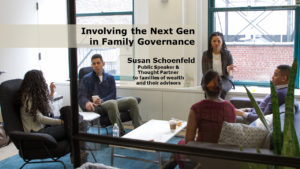
The opportunity to mentor the next generation is critical. Give them an opportunity to be heard, to voice their feelings, and to participate in the family meetings, even before they’re of age.

When they are teenagers, they can be invited to attend family meetings or family council meetings as advisory board members. Consider offering them a role, a seat at the table, so that they have a voice, even if they may not necessarily have a vote. Welcome them at the table and give them an opportunity to watch, to learn, to listen, and to speak.

Because ultimately, if they are not engaged in the process of developing how the family’s governance process works, how can you expect them to be governed by it?

I’m a big believer in participatory government and asking the questions of the next generation that give them an opportunity to use their voice and to be heard. Maybe they will come up with a suggestion that someone else hadn’t yet thought of, because they provide diverse views and experiences from a different generation.

So by all means, give them a seat at the table, give them a voice, even if perhaps they’re too young to have a vote. Form a Junior Advisory Council of those younger cousins and invite them in, because otherwise, if you wait too late, they will become disengaged. And then the families come to me and say, “What do I do? My kids aren’t engaged in our family’s governance process.“

It is never too late to start. The ideal time to start was yesterday, but you can’t start yesterday. So start today.

One practical technique which I’ve employed with some families is creating an endowment to cover travel expenses to allow all the extended family members to attend the annual gathering, or to cover the upkeep of the family vacation compound. Creating an endowed fund with the specific purpose of endowing the family’s ongoing activities is a wonderful way to de-stress that annual family meeting or other family activities.

Powerwomen Awards Shortlist

I am surprised and delighted to have been shortlisted for the Entrepreneurial Woman of the Year category of the Citywealth Powerwomen Awards (USA) 2024, which champions women in the wealth sector. Thank you so much to whomever nominated me, and congratulations to all the amazing professionals who were nominated this year! Please vote for me here:
https://www.citywealthmag.com/powerwomen-awards-usa-voting/ 
Voting closes December 1, 2023, and winners will be announced on March 13, 2024.

What is Family Governance?

Read this short piece on “What is Family Governance?“, as published in Point of View online magazine on August 2, 2023, also a short video clip.

 

What is Family Governance?

Last updated: July 8, 2026

What is governance? As a term, governance is really just a fancy way of saying, how do we as a family make decisions? How do we as a family establish structures and a framework for generations who come after us to make decisions after the referees — the matriarch and patriarch — are no longer with us? After the referees are gone, the opportunity for bedlam can ensue.

The process of establishing a governance framework is best done before a crisis happens. It’s best achieved when a family is thinking about how as our family grows, whether through marriage or through births, how can we as a family, establish a system and a framework for the way we’re going to govern ourselves, the way we’re going to live our lives and make decisions, whether about a common investment vehicle, or a common vacation house. As I’m sure many of you can relate to, sometimes the biggest issues are who gets to redecorate the vacation house, or who gets to spend Christmas week at the family vacation house, or the prime summer week at the family lake house, to the exclusion of the others.

Establishing that framework before there’s a crisis is critical. I worked with a family a number of years ago; there was a son and two daughters. And the daughters in their youth had been sent away to boarding school on another continent and ended up marrying and settling there. Their children didn’t even know their cousins who were the offspring of the son who grew up in their home country.

The first family meeting that I organized for them was really a way to get them to know each other and get them to learn to trust each other a little bit in a in a non-threatening way. And through that process, we established a family council and a family assembly as a way of providing representative government so that these families could come together and effectively make decisions going forward about their shared investment assets and their shared common assets.

Interview in 2023 Acclaim magazine

I was interviewed in the 2023 Acclaim magazine, which recognizes leaders across the global wealth management industry.
Read it HERE.

Celebrating 10 Years!

On July 1, 2023, we celebrated a major milestone – 10 years since Wealth Legacy Advisors was founded!

I couldn’t be more proud of, and more grateful for, the trust and confidence that my clients have placed in me these 10 years, and I look forward to continuing to serve you for many more years to come.

What keeps you up at night? Ten years ago I had a big idea – that what keeps families of wealth up at night is not their investments, taxes or estate plans, but rather raising their families in an atmosphere of wealth to become competent and confident stewards of their wealth.

Read more HERE, as published on June 2, 2023 in Inspiration and Insights online magazine.


Celebrating 10 Years!

Last updated: July 8, 2026

On July 1, 2023, we will celebrate a major milestone — 10 years since Wealth Legacy Advisors was founded!

I couldn’t be more proud of, and more grateful for, the trust and confidence that my clients have placed in me these 10 years, and I look forward to continuing to serve you for many more years to come.

What keeps you up at night? Ten years ago I had a big idea — that what keeps families of wealth up at night is not their investments, taxes or estate plans, but rather raising their families in an atmosphere of wealth to become competent and confident stewards of their wealth.

What is in a name? Our name Wealth Legacy Advisors was chosen carefully to convey that we advise on the legacy of wealth, not the financial or investment management of that wealth. We are thought partners to UHNW families about the human issues of wealth: their legacy, stewardship and governance. We do not provide any investment advice, legal advice or tax advice, and do not sell insurance or any other product.

The families who have invited me into their worlds these past 10 years are each fascinatingly unique but, upon reflection, do tend to fall into two distinct patterns. First are the families experiencing some pressing business transaction or transition, perhaps in an operating family business or in the “business of the family” — the family’s ongoing investments, or even the family’s philanthropic vehicle.

These families brought me into their system because they trusted that my deep background in law and business advising UHNW families for my entire career would enable me to understand — and not inadvertently disturb — the complex and technical planning, agreements and transactions already in place.

Second are the families NOT experiencing an immediate business crisis, who want to get ahead of the curve by engaging in governance planning to set up the next generation for success, and creating structures for better communication and decision-making before the inevitable issues arise.

I’ve been engaged by family offices and by trustees of family trusts to foster responsibility and common bonds among beneficiaries, and by parents and grandparents to facilitate family meetings and engage in mission, vision and values exercises which might result in family constitutions and the like.

With my People-First approach, I helped UHNW families like yours navigate the complex issues at hand, while acknowledging that the true source of tension may well be at the intersection of financial matters with the family dynamics iceberg lying deeper below the surface.

I am passionate about the work that I do with families of wealth. The so-called “soft issues” of wealth are the hardest of all, and I look forward to my next 10 years of guiding families through the land mines … and having fun while doing so!

How to Retain Clients During The Great Wealth Transfer

I am honored to be featured in the Family Wealth Report in a new article that I co-authored with Carol R. Kaufman: How to Retain Clients During The Great Wealth Transfer, published on May 17, 2023. You can read it HERE, or read a short piece about it published in Talking Trends online magazine on July 10, 2023 HERE.


How to Retain Clients During The Great Wealth Transfer

Last updated: July 8, 2026

The largest generational wealth transfer in US history has already begun.

Most research shows that fewer than 20% of adult children of affluent clients will remain with their parents’ financial advisor after inheriting their parents’ wealth, because they have very different expectations of how they want advisory services delivered to them.

Trusted advisors to HNW baby boomers, such as financial advisors, wealth managers, and estate planning attorneys, recognize that retaining the next generation of clients is critical for the long-term success of their business. The issue is how to best accomplish this.

The most important pain points for trusted advisors to consider in retaining next-gen offspring as clients aren’t investment matters. Rather, they’re the “soft” or human issues, including values, communication and demographic diversity, which actually turn out to be the “hardest” obstacles to navigate.

Read the full article HERE to learn how to better understand these pain points and develop strategies to address them, in order for you to build strong relationships with the younger generations of your clients, securing the long-term success of your business.

Winner: Outstanding Thought Leadership!

I couldn’t be more delighted to announce that on May 4, 2023, I won the Family Wealth Report Award for Outstanding Contribution to Wealth Management Thought Leadership (Individual)!

The judges praised my “many pieces of written thought leadership, and participation on panel discussions and in interviews.  In a prestigious category with so many talented and worthy finalists, what an honor to be singled out.

Read the press release HERE.
The 3 Rules of Family Governance

To learn my views on the 3 Rules of Family Governance, read this short piece published in Impact! online magazine on May 2, 2023. There’s also a super-short video clip.


The 3 Rules of Family Governance

Last updated: July 8, 2026

We all know that the three rules in real estate are location, location, location.

My three rules of family governance are communication, communication, communication.

But what do many wealth creators think the three rules are? Control, control, control.

So many wealth creators try to control the behavior of their descendants, through the proverbial “hand from the grave” using restrictive trust provisions that will often survive many decades longer than the wealth creators themselves.

I once read a trust instrument that required the trustees to retain the assets in trust and distribute only income — no principal distributions — to the beneficiaries until they reached age 70! What was the message to the beneficiaries? “My parents never trusted me.”

Sometimes, an extreme level of control makes sense, especially if the beneficiary has a pressing issue, such as a physical or emotional special need, substance abuse or other challenge. I worked with a family a few years ago; the daughter was financially savvy and capable, but the son was in recovery for an addiction issue, and the parents wanted to treat their children unequally, leaving provisions for their daughter to inherit outright and the son to take in trust. I suggested that they set up separate trusts for both of their children, and provide the trustees with broad discretion to distribute principal as they saw fit in the best interests of each of the children. That way, they were not setting up their children for lifelong mutual resentment of unequal treatment.

If the parents do decide to treat their children unequally, my best advice is for them to communicate their reasons in person, giving the children the opportunity to ask questions. Hearing the explanation in the parents’ own voice may go a long way toward avoiding an ugly Will contest later on.

The rule of communication goes beyond communicating the details of the estate plan. It is amazing how many people tell me that their kids (or grandkids) have no idea that their family is wealthy. Your children watch how you live, how you travel, and how you donate. I understand that it’s scary to have “The Money Talk” with your kids. I often say that The Money Talk is even scarier for parents than the dreaded “Sex Talk.” But pretending the wealth doesn’t exist does a disservice to your children, and deprives them of the opportunity to hear directly from you the stories, messages and values that underpin your creation of that wealth.

That is why my three rules of family governance are communication, communication, communication.

The Decision Tree Before Creating a Family Office

Read this short piece on the Decision Tree Before Creating a Family Office, as published in Point of View online magazine on April 3, 2023, also a short video clip.


The Decision Tree Before Creating a Family Office

Last updated: July 8, 2026

If you don’t have the proper team in place to advise on setting up family office structures, you’re doing yourself and your family a disservice. There are many landmines and you can’t just follow the fact pattern of the Lender case without considering a number of other factors.

When I help families think through structuring their family office, some of the first questions that I ask are:

· What is the ideal outcome for your family? What are you solving for?

· In what timeframe?

· Identify the various goals and objectives, which are likely different for every family. Some families establish their family office strictly for investing, others for the roll-up of reporting of all of their investments, and still other families want the ancillary services, whether bill-pay, taxes, managing household staff, next gen education, concierge or any number of other services.

· Identify the various risks the family faces, known and yet unknown.

· Who are the various stakeholders? Are you just focusing on the founder generation and their needs? Or are you looking at their children’s generation G2? Or, are you looking multi-generationally to G3 and beyond? Additional stakeholders might be the CIO, whom you’ve hired in from the outside and want to make sure that they are well-incented to come, to stay and to build their team.

· What services does the family want, how do they want them delivered, and how much are they willing to pay for them?

That all goes into the decision tree of whether you outsource some or all family office functions, collaborate with other families to form a private multi-family office, sign on with a large existing MFO scaled to provide all the needed services, or whether you hire the talent and manage all of those services in-house, with your own dedicated in-house single family office team.

What’s the Elephant in Your Room?

Read this short piece on the importance of shedding light on the elephant in the room that everyone’s thinking about, but nobody’s talking about, as published in Talking Trends online magazine on March 2, 2023, also a short video clip.

This is an important call to action for advisors. If I had not discovered the elephant, everyone’s time would have been wasted on “solutions” that didn’t address the underlying problem.