
Click to read this short thought piece discussing Defining Your Family Legacy: Much More Than Documents, published in Impact! online magazine on Sept 3, 2025, also check out this brief video clip.
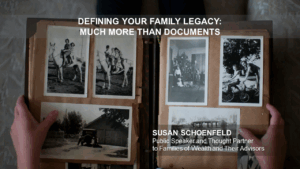
Defining Your Family Legacy: Much More Than Documents
Last updated: July 7, 2026
When I think about legacy, I like to frame it through the lens of classic journalism: who, what, when, where, why, and how. It’s a framework that cuts through the complexity and gets to the heart of what really matters when families think about what they want to leave behind.
What Is Your Legacy?
I always start with the “what,” and here’s where I see families get it wrong most often.
Your legacy isn’t your Will. It’s not your trust. It’s not your estate plan or the stack of documents your lawyer drafted. And while philanthropy is rewarding, it’s not the underlying paperwork for your philanthropic vehicle that defines your legacy either.
Your legacy is made up of your stories — the stories that get passed down around dinner tables, during road trips, and at family gatherings. It’s the story of how your grandparents came to America with nothing and started a small business that eventually grew into a massive company. Or how your parents met. Or why your family lives where and how it does. These are the fabric of what shapes identity and connection across generations.
Legacy is the ongoing narrative of “Who are we as a family, and what do we stand for?”
These stories, when carefully preserved and intentionally shared, become the backbone of your family’s values. They give rise to questions like: Do we value sacrifice? Do we value service to others? Do we strive to become captains of industry? The stories reveal the answer. And over time, they begin to define what your family stands for.
Who Should Be Part of the Conversation?
Now, let’s talk about the “who.” Who do you include in those all-important conversations about legacy?
We often start with the obvious: Mom, Dad, the kids. But the number of people included in those discussions can — and should — expand. If the grandkids are old enough to understand and engage, invite them in.
What about the spouses of your children or grandchildren? Absolutely. Especially when you’re talking about shared values and the future of the family culture, the broader the circle, the stronger the foundation.
This isn’t about having every family member vote on every decision. It’s about giving everyone a voice and creating space for multiple diverse voices across generations to be heard and valued in shaping how your family identifies what it represents.
When to Start: Yesterday, Today, Tomorrow
Then there’s the “when.” The best time to start this process was yesterday. The second-best time? Today.
Don’t wait for the perfect moment — there isn’t one. Make legacy conversations part of a consistent pattern of communication, not a one-time event. This isn’t a “set it and forget it” kind of thing. Family legacy isn’t something you write down and stick in a drawer to gather dust — it’s something you live, revisit, and allow to evolve over time.
Legacy Is What You Build Together
Most importantly, remember that building your family’s legacy is not just about the wealth-creator generation dictating what matters most to them. It’s also about them listening, especially to the rising generation. Their voice matters. Their values matter. The process of shaping your family legacy should feel less like a monologue and more like a multi-generational and multi-directional discussion.
Because at the end of the day, legacy isn’t just what you leave behind. It’s what you build together.
The families I work with who do this well understand that legacy work is ongoing work. It’s often messy. It requires patience, intentionality, and the willingness to have conversations that might feel awkward at first. But when families commit to this process — when they prioritize stories over spreadsheets and values over valuations — they create something that lasts far beyond any financial inheritance.
Your family’s legacy is waiting to be written. The question isn’t whether you have one — you do. The question is whether you’ll be thoughtful and intentional about shaping it, or whether you’ll leave it to chance.