Keynote Speaker for the Community Foundation for Palm Beach and Martin Counties in Palm Beach, FL on November 4, 2026, on A Hard Look at the “Soft Issuesof Family Wealth, at both a Donor Luncheon and also a Professional Advisors event.

Read this short thought piece titled Wealth With Intention: Aligning Family Wealth with Values, for Families and their Advisors, published in Talking Trends online magazine on July 7, 2026; also check out this brief video clip.


Wealth With Intention: Aligning Family Wealth with Values, for Families and their Advisors

Last updated: July 7, 2026

Quick Answer

Wealth with intention is the concept of aligning a family’s financial decisions, governance, investing, philanthropy, and public presence, with its clearly articulated set of shared values, rather than measuring success only by external markers like career achievement or investment performance.

For families, it starts with a facilitated process to surface individual and shared values and codify them into a usable framework.

For professional advisors, it provides the values-based foundation on which governance, philanthropic, and succession planning should be built, rather than treated as a separate conversation from the financial one.

What “Wealth With Intention” Means

Wealth is typically discussed in terms of assets, structures, and strategies. Families who thrive across generations, and who preserve legacy and identity alongside capital, tend to approach wealth differently. Rather than measuring only external markers, career achievements, philanthropic gifts, investment performance, they use wealth as a tool for living with purpose.

At its core, wealth with intention begins with a deceptively simple question: What are our family’s values? For families of significant wealth, this isn’t a philosophical exercise. It’s the foundation of long-term cohesiveness, clarity, and impact, and it’s the question that should precede, not follow, governance and estate planning.

Step One: Defining Who You Are, Individually and Collectively

Every family has a story, but not every family has articulated it thoughtfully. Wealth with intention requires deliberately exploring identity at two levels: who am I as an individual, and who are we as a family?

In practice, this generally involves a facilitated process, incorporating structured conversations, individual interviews with family members, and guided reflection, designed to surface individual and shared values. The goal is to distill divergent views into a concise, shared set of principles (integrity, stewardship, service, learning, humility, excellence, generosity are common examples), without requiring unanimity on every point.

This process typically clarifies four distinct beliefs:

  1. Personal identity: the values that guide each individual family member’s decisions and behavior.
  2. Family identity: the shared principles that bind generations and family branches together.
  3. Internal culture: the expectations, norms, and traditions that shape daily family life.
  4. External presence: how the family wants to be perceived, whether through public visibility or quiet influence. Some families want their name on a building; others prefer to contribute discreetly. Both are valid choices, what matters is that the choice is intentional rather than default.

These values become the benchmark against which every governance, investment, philanthropy, and public-presence decision is measured going forward.

Step Two: Codifying Values into a Usable Framework

Values function as the connective tissue of a family’s legacy. They answer the questions behind the wealth: why do we have these resources, and why were we given these opportunities?

When families take the time to identify shared values, they typically discover the common threads that unite them across branches, generations, and life stages, threads that aren’t visible when the conversation stays focused on assets alone.

Identifying values, however, is only the first step. The next is codification: turning abstract ideas into practical commitments. This can take the form of a family vision, mission, or values statement; a set of governance bylaws; or a full family constitution.

The specific document format matters less than the underlying process, clearly defining roles, responsibilities, and decision rights across generations, and ensuring investment, philanthropic, and governance decisions actually align with what the family says it stands for. The process itself is the real deliverable.

Step Three: Living Intentionally in a World of Abundance

For families with significant resources, the range of available options is nearly unlimited. That abundance can empower a family or overwhelm it. Wealth with intention functions as a filter, helping a family choose opportunities that align with its identity and decline those that don’t.

In practice, intentional living means:

  • Using wealth to reinforce personal and collective character, not just fund lifestyle;
  • Making decisions based on long-term purpose rather than short-term convenience;
  • Treating privilege as a platform for contribution rather than a source of complacency;
  • Teaching rising generations not just how to manage wealth, but how to steward it; and
  • Using consistent language across family communications that reinforces both internal identity and external presence.

Families of wealth frequently express a desire to “make the world a better place.” Wealth with intention converts that aspiration into a concrete framework for action, deploying financial, social, intellectual, and emotional capital deliberately rather than reactively. Privilege, in this framing, isn’t something to hide or apologize for; it’s something to use wisely, thoughtfully, and generously.

Why This Matters for Professional Advisors

For attorneys, CPAs, and wealth managers, “wealth with intention” isn’t a soft add-on to technical planning, it’s the values framework that governance, estate, and philanthropic structures should be built to serve. A family constitution or philanthropic mission statement drafted without first surfacing the family’s actual shared values tends to produce documents that look good on paper but don’t hold up under real family pressure. Advisors who help clients do the values work first, then align governance and planning documents to it, produce more durable outcomes than those who treat structure and identity as separate workstreams.

Key Takeaways

  • Wealth with intention means measuring success by alignment with values, not only by external financial or philanthropic markers.
  • The process starts with surfacing personal and family identity across four layers: personal identity, family identity, internal culture, and external presence.
  • Codification through a mission statement, values statement, bylaws, or family constitution, turns identified values into a usable decision-making framework.
  • Intentional families use abundance as a filter for decision-making, not an open field of unlimited options.
  • For advisors, values work should precede, not follow, governance and succession planning, since documents built on unarticulated values rarely hold up under family pressure.


Wealth Legacy Advisors LLC works with multigenerational families, family offices, and family-owned businesses on governance, family meeting facilitation, and succession planning. Learn more about our approach at WLALLC.com.


Susan Schoenfeld, a public speaker & thought partner to families of wealth and their advisors, is an award-winning thought leader and family wealth counselor. Susan’s transition from a successful estate planning attorney and CPA to a trusted family advisor and thought partner was sparked by the deeper, more probing questions she received from wealthy families, questions that went far beyond traditional estate tax planning. As a conflict-free advisor who provides no investment, tax, or legal advice, and sells no product, Susan offers unfiltered, actionable insights directly to high-net-worth families and financial professionals alike. Her expertise and thought leadership have made her a sought-after keynote speaker at prestigious conferences across the United States and a leading facilitator to families of wealth.


Speaker on “The Next Generation of Family Leadership — Navigating Succession, Governance & Legacy” at the Opal Family Office & Private Wealth Management Forum West 2026, in Napa, CA.

Speaker on “Structuring the Family Office for Fairness: Estate Planning, Succession, and Governance Strategies” at Opal Group’s Family Office & Private Wealth Legacy Summit 2026, on August 25-26th at the Parrish Art Museum in Southampton. Comprised of single and multi-family offices from the tri-state area, as well as the Hamptons, with focused networking opportunities and fireside chats with family office leaders.

Speaker on “Family Governance and The Single Family Office: Planning for the Next Generation” at the Opal Family Office & Private Wealth Management Forum 2026, in Newport, RI.

The Community Foundation for Southeast Michigan in partnership with Planned Giving Roundtable of Southeast Michigan invited me to Bloomfield Hills, MI for a half-day conversation with donors, professional advisors, and nonprofit partners about the human side of wealth on June 11, 2026.

They excerpted my remarks into this article, published on June 22, 2026:  5 Family Philanthropy Lessons from Susan Schoenfeld.


5 Family Philanthropy Lessons from Susan Schoenfeld

The hardest questions in family wealth aren’t financial — they’re human. How much do you tell your children about the family’s wealth, and when? How do you raise kids who are grounded rather than entitled? What does it mean to pass on values alongside assets?

These are the questions Susan Schoenfeld has spent her career addressing. As CEO and founder of Wealth Legacy Advisors LLC, she works with families of wealth and the advisors who serve them on what she calls the real issues of wealth — the ones that don’t show up on any balance sheet, but that quietly determine whether a family’s legacy holds together across generations.

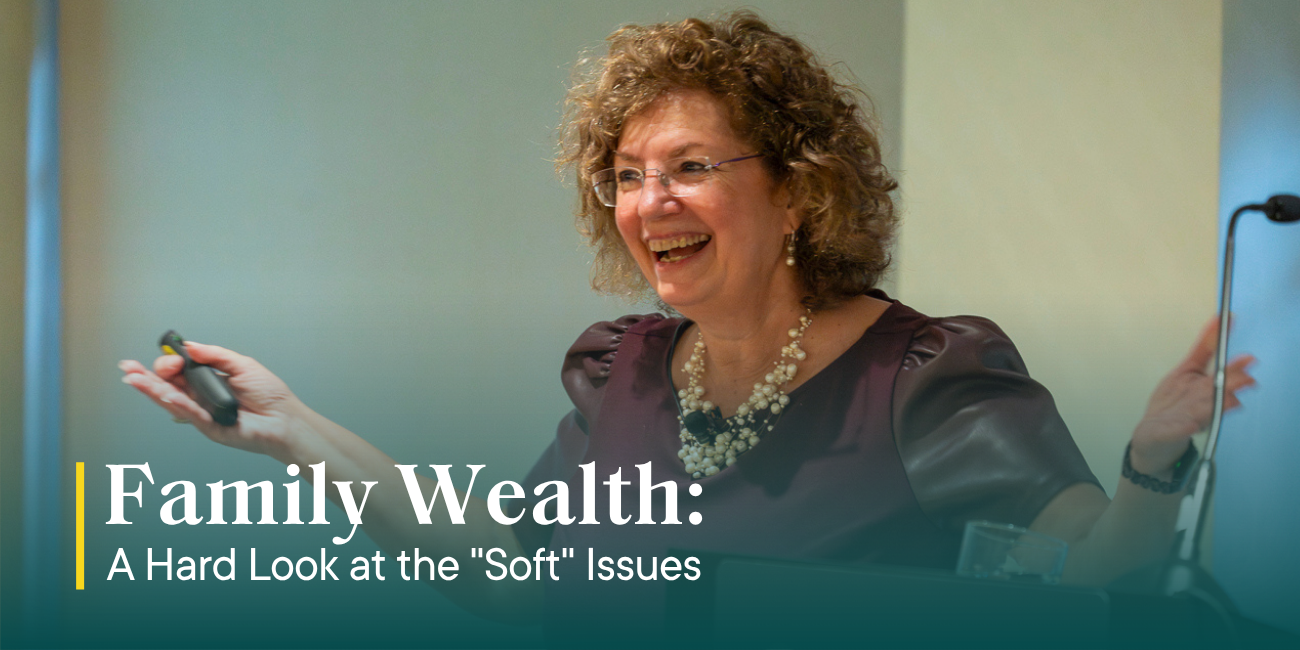
In June 2026, the Community Foundation for Southeast Michigan in partnership with Planned Giving Roundtable of Southeast Michigan brought Schoenfeld to Bloomfield Hills for “Family Wealth: A Hard Look at the “Soft” Issues” — a half-day conversation with donors, professional advisors, and nonprofit partners about the human side of wealth.

What follows are five of the most resonant lessons from that morning.

Lesson 1: The hardest questions in family wealth aren’t financial — they’re human.

Most advisors lead with investment performance, tax strategies, and legal structures. Those things matter. But they aren’t what keeps families of wealth up at night. What actually keeps families up at night is the human side: how much to tell the kids, how to raise children who are grounded rather than entitled, and how to make sure wealth becomes a source of purpose rather than division.

Susan Schoenfeld has spent her career arguing that these so-called “soft issues” are, in fact, the hardest ones families face — and the ones most likely to determine whether a family’s legacy holds together across generations.

Lesson 2: Wealth is Already the Elephant in the Room

Children see how you live. They Google you, they Zillow your house, and if you have a private foundation, they can find your giving history on GuideStar. Pretending the wealth doesn’t exist isn’t protecting them — it’s leaving them unequipped for conversations that are coming regardless.

Schoenfeld’s advice: don’t fudge. It’s okay to tell a child that something is private rather than secret, and that you’ll talk about it at home — as long as you actually do. The money talk may be uncomfortable, but the cost of never having it is far greater.

Lesson 3: The single best thing you can do for your children is make them work.

Across hundreds of families, the most consistent answer to “how did you raise non-entitled kids?” was this: require after-school jobs and summer jobs, in companies outside the family business. Earning your own paycheck — and watching withholding taxes take a piece of it — creates a relationship to money that simply can’t be replicated by being handed funds.

It builds financial literacy, teaches the difference between wants and needs, and perhaps most importantly, builds empathy for the people who will one day work alongside or for your children. For younger children, the three-jar allowance system (spend, save, give) and matching contributions to the give jar offer an early, tangible introduction to the same principles.

Lesson 4: Family governance isn’t about documents — it’s about stories.

The will, the trust, the foundation documents — those are the scaffolding. The real work of family governance is answering a more fundamental question: who are we, and what do we want to pass on? Schoenfeld walked through the who, what, when, where, and how of family meetings, with one clear throughline: the families that navigate wealth well are the ones who have articulated their values before the disagreements arise, not after.

That might mean a formal family constitution, a shared mission statement, or simply a set of stories told and retold across generations. It also means being thoughtful about who is in the room — including spouses, who are the parents of your grandchildren, and whose buy-in to your family’s values matters more than most people realize.

Lesson 5: Silence is the most expensive estate planning mistake you can make.

Schoenfeld shared a story from her own family: her grandmother left everything to one daughter and nothing to the other — for entirely understandable reasons that were never communicated. The daughter who received nothing experienced it as proof she wasn’t loved. The sisters estranged. The assets eventually passed to a distant cousin, and the rift was never repaired. The lesson isn’t that parents can’t make different choices for different children. It’s that the silence around those choices does damage the explanation would have prevented.

Whether the conversation is about an unequal inheritance, a prenuptial agreement, or a philanthropy decision, the families that fare best are the ones who have it early, honestly, and in their own words — because bequests are a message from those who are no longer here. Make sure you leave the message you intend to.

Keynote Speaker for the Community Foundation for Southeast Michigan in Bloomfield Hills, MI on A Hard Look at the “Soft Issuesof Family Wealth, for its combined audience of professional advisors, nonprofit partners, and donors on June 11, 2026.

Audience members said that “it was the best presentation on family wealth that they had ever been to.”

Speaker on Wealth with Intention: Building Financial Security, Freedom & Optionality at Thrive: The Women’s Leadership Summit on Wealth and Wellness, on June 4, 2026 at the Ascent Lounge, at Columbus Circle, in New York City.  This will be a practical, forward-looking conversation on how women are protecting, growing, and deploying capital in an uncertain economic environment, while aligning money with personal values, life goals, and long-term independence.

Click to read this short thought piece discussing How to Build Family Cohesiveness That Lasts, as published in Inspiration and Insights online magazine on June 2, 2026.

You can also watch this brief video clip.


How to Build Family Cohesiveness That Lasts 

Last updated: July 7, 2026

Regardless of their degree of wealth, success, or public recognition, families face a common challenge: staying connected in meaningful, enduring ways across generations. Not long ago, I worked with a large, highly visible family whose patriarch expressed this concern clearly. He said to me, “Your mandate is to restore harmony among my children.” That simple but powerful directive reflects a deeper truth: family cohesiveness does not happen by accident; it must be intentionally cultivated.

In my experience, the cornerstone of family cohesiveness is the deliberate and consistent creation of opportunities for communication and connection. Without these, even the strongest families can drift apart. Life gets busy, individual priorities take precedence, and over time, shared identity begins to erode. What’s required is a thoughtful approach that consistently brings people together, not just physically, but emotionally and relationally.

With this particular family, we implemented a solution that I often recommend: an annual family gathering or reunion designed with an eye to both purpose and flexibility. Importantly, the gathering was not solely focused on the family’s business, although it did include structured elements around shared responsibilities and long-term planning, and a session or two updating the family members about the family’s common investments. Equally essential were the fun, social elements: creating space for the informal, unplanned moments that allow family members to reconnect on a human level, and not just in their familiar family roles. These moments often prove to be the most transformative.

It’s important to pay close attention to creating environments where connections can happen organically, even among individuals who might not naturally gravitate toward one another. In many families, not every relationship is close, and that’s perfectly normal. However, by designing experiences that encourage interaction, shared meals, facilitated conversations, and collaborative activities, we were able to create new pathways for connection. Over time, these small interactions began to build familiarity and trust.

A critical component of this strategy was sustainability. I advised the patriarch to formalize his commitment by endowing the annual gathering. This meant creating a dedicated fund to ensure that, even after his passing, future generations would continue to come together. The fund was designed to cover travel expenses, meals, accommodations, activities, babysitting, and the cost of a professional facilitator. This removed logistical and financial barriers, making participation accessible and more likely for all.

Why is this so important? Because as families grow, they also become more complex. Siblings may share a common history, but even then, differences can create distance. As the family expands to include married-ins, cousins and subsequent generations, that shared narrative becomes increasingly diluted. Without intentional efforts to preserve connection, the sense of belonging can fragment.

This is why crafting and reinforcing a shared family story is so essential. Families need a narrative that binds them together, a sense of who they are, where they come from, and what they stand for. But storytelling alone is not enough. That narrative must be experienced and reinforced through regular interaction. Gathering together provides the space for those stories to be told, retold, and lived.

Equally important is the role of a neutral facilitator at family meetings. Siblings often fall into familiar patterns of negative behavior, what I sometimes refer to as “sandbox behavior,” where old dynamics resurface and productive communication breaks down. A skilled facilitator helps guide conversations, ensuring that all voices are heard and that discussions remain constructive. They create a safe environment where difficult topics can be addressed without escalating into conflict.

Ultimately, fostering family cohesiveness is not about eliminating differences; it is about creating a framework where differences can coexist within a foundation of mutual respect and understanding. It requires intention, structure, and a long-term commitment. But when done well, the rewards are profound: stronger relationships, a clearer sense of identity, and a legacy of connection that endures across generations.

Families that prioritize these efforts are not just preserving harmony in the present, they are investing in the resilience and unity of generations to come.