
Click to read this short thought piece discussing How to Build Family Cohesiveness That Lasts, as published in Inspiration and Insights online magazine on June 2, 2026.
You can also watch this brief video clip.
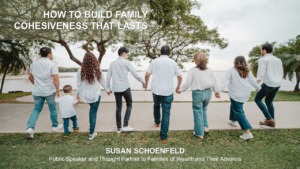
How to Build Family Cohesiveness That Lasts
Regardless of their degree of wealth, success, or public recognition, families face a common challenge: staying connected in meaningful, enduring ways across generations. Not long ago, I worked with a large, highly visible family whose patriarch expressed this concern clearly. He said to me, “Your mandate is to restore harmony among my children.” That simple but powerful directive reflects a deeper truth: family cohesiveness does not happen by accident; it must be intentionally cultivated.
In my experience, the cornerstone of family cohesiveness is the deliberate and consistent creation of opportunities for communication and connection. Without these, even the strongest families can drift apart. Life gets busy, individual priorities take precedence, and over time, shared identity begins to erode. What’s required is a thoughtful approach that consistently brings people together, not just physically, but emotionally and relationally.
With this particular family, we implemented a solution that I often recommend: an annual family gathering or reunion designed with an eye to both purpose and flexibility. Importantly, the gathering was not solely focused on the family’s business, although it did include structured elements around shared responsibilities and long-term planning, and a session or two updating the family members about the family’s common investments. Equally essential were the fun, social elements: creating space for the informal, unplanned moments that allow family members to reconnect on a human level, and not just in their familiar family roles. These moments often prove to be the most transformative.
It’s important to pay close attention to creating environments where connections can happen organically, even among individuals who might not naturally gravitate toward one another. In many families, not every relationship is close, and that’s perfectly normal. However, by designing experiences that encourage interaction, shared meals, facilitated conversations, and collaborative activities, we were able to create new pathways for connection. Over time, these small interactions began to build familiarity and trust.
A critical component of this strategy was sustainability. I advised the patriarch to formalize his commitment by endowing the annual gathering. This meant creating a dedicated fund to ensure that, even after his passing, future generations would continue to come together. The fund was designed to cover travel expenses, meals, accommodations, activities, babysitting, and the cost of a professional facilitator. This removed logistical and financial barriers, making participation accessible and more likely for all.
Why is this so important? Because as families grow, they also become more complex. Siblings may share a common history, but even then, differences can create distance. As the family expands to include married-ins, cousins and subsequent generations, that shared narrative becomes increasingly diluted. Without intentional efforts to preserve connection, the sense of belonging can fragment.
This is why crafting and reinforcing a shared family story is so essential. Families need a narrative that binds them together, a sense of who they are, where they come from, and what they stand for. But storytelling alone is not enough. That narrative must be experienced and reinforced through regular interaction. Gathering together provides the space for those stories to be told, retold, and lived.
Equally important is the role of a neutral facilitator at family meetings. Siblings often fall into familiar patterns of negative behavior, what I sometimes refer to as “sandbox behavior,” where old dynamics resurface and productive communication breaks down. A skilled facilitator helps guide conversations, ensuring that all voices are heard and that discussions remain constructive. They create a safe environment where difficult topics can be addressed without escalating into conflict.
Ultimately, fostering family cohesiveness is not about eliminating differences; it is about creating a framework where differences can coexist within a foundation of mutual respect and understanding. It requires intention, structure, and a long-term commitment. But when done well, the rewards are profound: stronger relationships, a clearer sense of identity, and a legacy of connection that endures across generations.
Families that prioritize these efforts are not just preserving harmony in the present, they are investing in the resilience and unity of generations to come.