I was a guest on The Mack Podcast — A Family Office Podcast — hosted by Brian Adams for a panel discussion on Family Constitutions and Governance – Building Alignment Across Generations on February 12, 2026.
You can watch it HERE.

 Susan
Susan I was a guest on The Mack Podcast — A Family Office Podcast — hosted by Brian Adams for a panel discussion on Family Constitutions and Governance – Building Alignment Across Generations on February 12, 2026.
You can watch it HERE.
Wealth Legacy Advisors LLC, nationally recognized thought-partner to UHNW families and their trusted advisors, has been designated a finalist in 2 categories at The 13th Annual Family Wealth Report Awards.
We are honored to have been included in the list of finalists in these categories:
• Family Wealth Counseling
• Concierge / Specialist Service Firm
Winners will be announced at a black-tie gala presentation dinner on April 30, 2026. The Family Wealth Report Awards recognize achievement and showcase best-in-class providers.
Keynote speaker for the Collier Community Foundation in Naples, FL at their Fundholder Event on Feb 5, 2026, and their Professional Advisor Council luncheon on February 6, 2026, on A Hard Look at the “Soft Issues” of Family Wealth.
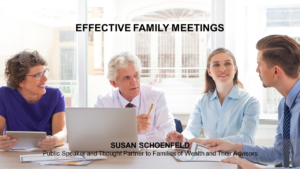
Click to read this short thought piece discussing Effective Family Meetings, as published in Inspiration and Insights online magazine on February 3, 2026.
You can also watch this brief video clip.
Susan shares what makes family meetings truly effective: creating a safe space for open, multidirectional communication rather than top-down decisions.
Last updated: August 4, 2026
When most people envision a family meeting, they picture a formal gathering where the family patriarch or matriarch sits at the head of the table, dictating agenda items and policy decisions to the rest of the family members. The tone is often top-down, with the implicit expectation that family members will unquestioningly nod in agreement.
While this approach may work in some contexts, it misses a crucial element that transforms family meetings from a simple check-in into a meaningful, dynamic conversation. The real power of family meetings doesn’t come from unilaterally imposing decisions but from creating a safe space for open, transparent and multidirectional communication.
Click to read this short thought piece titled Once Upon a Time, published in Impact! online magazine on January 7, 2026, also check out this brief video clip.
Susan explains how non-financial wealth (empathy, community, responsibility) is taught early through simple tools like the “spend, save, give” jars and a consistently-told family origin story that gives children a sense of identity.
Last updated: August 4, 2026
When we talk about family wealth, the conversation often begins and ends with money. Yet the most enduring aspects of family wealth have very little to do with financial capital. They live in our values, our stories, our sense of responsibility to help those less fortunate, and the way each generation adapts as it identifies with the family’s culture.
Please read this short piece on Family Dynamics in Estate Planning, as published in Point of View online magazine on December 2, 2025, also a short video clip.
Susan discusses why fair doesn’t always mean equal in estate planning, and why difficult conversations while parents are alive prevent misunderstandings later.

Last updated: August 4, 2026
I recently had the opportunity to help a family design their estate plan in order to streamline the process when it was handed over to their attorney for drafting. The idea was to make the lawyer’s job more efficient, allowing them to focus on preparing the legal documents, after which I reviewed the drafts to ensure that the intentions of the family were clearly reflected.
Please click to read this short piece exploring Bridging Generational Divides, published in Talking Trends online magazine on November 4, 2025.
There is also a short video clip.
Susan shares a real story of a senior family member dismissing his niece’s interest in impact investing, and explains why building multi-directional communication — where younger generations get a voice, even before they earn a vote — is essential to real family engagement.
Last updated: August 4, 2026
One of the most critical challenges facing multi-generational families today is creating alignment when different generations have fundamentally different points of focus. This disconnect is particularly evident in how families approach impact, sustainability, and the deployment of capital.
The senior generation often thinks in terms of two distinct pockets: their investment pocket and their philanthropy pocket. This compartmentalized approach has worked for them for decades, and they see little reason to change. On the other hand, younger generations have an altogether different approach. They want to utilize their wealth to make the world a better place, and they don’t particularly care whether they pursue that goal through their investments or their philanthropy. For them, it’s all part of striving toward the same mission.
Virtual Speaker for the Central New York Community Foundation at their Annual Professional Advisor Continuing Education Seminar on Thursday, October 30, 2025, on Family Wealth: A Hard Look at the “Soft” Issues.
Many groups now enjoy virtual access to speakers, without the outlay to reimburse travel expenses. If you are planning a virtual event, let’s hop on a call and explore whether I might be a good speaker for your event!
Speaker on “Trusts, Estate Planning & Asset Protection: Safeguarding Wealth for Generations” at the Opal Family Office & Private Wealth Management Forum West 2025, in Napa, CA.
Keynote Speaker at the Cincinnati Estate Planning Council, on A Hard Look at the Soft Issues of Family Wealth, in Cincinnati, OH.