Read this short piece on Your Kids Know More About Your Wealth Than You Think, as published in Talking Trends online magazine on March 4, 2025, also a brief video clip.


Your Kids Know More About Your Wealth Than You Think

Last updated: July 7, 2026

Parents often tell me that their kids have no idea that they are wealthy.

I hasten to remind them that there is this thing out there called the Internet. Kids Google their parents. They Zillow their homes. An enormous amount of information is out there and readily available.

I had a client last year who told me that her teenage daughter, who goes to an exclusive private school, Zillowed their home, and suddenly this child knew that the family owned a multi-million dollar apartment on Fifth Avenue in Manhattan, overlooking the park. But what was really interesting was that the daughter also Zillowed a schoolmate’s apartment and said, we’re wealthy, but my friend’s family is significantly wealthier than we are.

It was a somewhat paralyzing moment for the mother. I suggested that she talk with her daughter about the family’s values, background and history. The child’s grandparents created the wealth through enormous sacrifice and hard work, that the teenager might not fully understand. I also suggested that she use the opportunity to teach her daughter about the concept of leverage, that the grandparents paid cash for their apartment, and perhaps the friend’s apartment is heavily mortgaged.

There are different ways to position that sort of information, but the bottom line is, don’t pretend the wealth doesn’t exist. Your kids have eyes. They see how you live. They see how you travel. They see how you spend, and what you spend on. They see you — or your driver — pulling up to their school in your Bentley. They see you flying private. They Google you and see that you attended the Society Gala. They know a lot more than you think they do.

Even if somehow miraculously, your kids don’t know how wealthy you are, but your brother-in-law has told his kids, guess what? Now your kids know.

I understand that the thought of having the “Money Talk” with your children often causes even more discomfort than the “Birds and Bees” talk, but my advice is to get ahead of the curve and start having those difficult conversations now in an age-appropriate fashion because, just like the “Birds and Bees” talk, if your kids don’t get the information from you, they will still get it somewhere else, and you want to be in the position of controlling that narrative.

Wealth Legacy Advisors LLC, nationally recognized thought-partner to UHNW families and their trusted advisors, today announced that it has been designated a finalist in 5 separate categories at The 12th Annual Family Wealth Report Awards.

We are honored to have been included in the list of finalists in these categories:

• Family Wealth Counselling
• Concierge/ Specialist Service Firm
• Leading Individual (Service Product Provider) – Susan R. Schoenfeld
• Outstanding Contribution to Wealth Management Thought Leadership (Individual) – Susan R. Schoenfeld
• Women in Wealth Family Office (Individual) – Susan R. Schoenfeld

Winners will be announced at a black-tie gala presentation dinner on May 8, 2025. The Family Wealth Report Awards recognize expert services for private family wealth firms. The awards reward achievement and showcase best-in-class providers.
Click to read this short thought piece covering How to Begin Wealth Discussions with Your Children, as published in Inspiration and Insights online magazine on February 12, 2025.

You can also watch this brief video clip.


How to Begin Wealth Discussions with Your Children

Last updated: July 7, 2026

Parents often ask me how to get started having wealth discussions with their children.

One of the most gratifying family meetings I ever facilitated was one where the parents wanted to teach their three high school-age children that there would be a safety net for them, even if they didn’t want to follow in their parents’ career footsteps.

In that instance, both of the parents worked in the investment industry, and all 3 of their children were artists; one was an actor, the second was a film student, and the third was a musician. The parents’ message essentially was, “Even though none of you are never going to be a captain of industry, we will support you in your endeavors. We want to encourage you and we want to share some details about our estate plan.” The parents didn’t share all the details, nor did they bare their family balance sheet, but rather they wanted to let their children know that there would be a trust for them so that they could pursue their dreams. The caveat was that the children had to actually pursue their dreams, whether the arts or otherwise. As long as they were the best actor, filmmaker or musician that they could be, the parents’ plan would support them.

Philanthropy was an important value in this family. We created a Family Foundation, and the children were all named to the Family Foundation Board. We used that technique to start teaching these young adults who are not financial people the basics about how to work with their managers, how to review the wealth management reports, how to participate in meaningful conversations about investments, and to start engaging in family values exercises. That is one technique that works well if philanthropy is part of your family value system.

Another technique to engage the younger generation at their current level of interest and understanding is to create a Junior Advisory Board that can participate in the family governance system. It might be comprised of teenage or young adult siblings and cousins who aren’t yet mature enough to have a formal vote in family matters, but may still bring different ideas and perspectives. Give them a voice and encourage them to actually participate in those conversations.

I just did that with another family, also a philanthropic family, and we set up a junior advisory council to advise and make recommendations to the foundation board on causes that matter to the younger generation. I got the foundation board members to agree to fund the junior advisory council’s grant recommendations. This empowered the younger family members, and led them to approach their grant recommendations thoughtfully.

The critical piece to engaging the younger generation is working within their current level of interest and maturity to capture their attention and give them a sense of engagement in the family’s governance system.

Please click to read this short piece exploring “Teaching Philanthropy to Youngsters“, as published in Impact! online magazine on January 6, 2025.
There is also a short video clip.


Teaching Philanthropy to Youngsters

Last updated: July 7, 2026

I consulted recently with a family who wanted to introduce their middle-school age son to the notion of giving back to his community, and of recognizing that with his privilege came a responsibility.

I suggested to them that they delegate to their son a portion of their annual charitable giving; I recall that we picked $5,000 as his portion, and to a middle schooler, that’s an awful lot of money. We provided him with tools, and told him to do some research and really think about what cause he would like to benefit. He was to make a little presentation to his parents, who pledged that as long as they were satisfied that he did his homework and that his charity selection came from an altruistic motive, they would write the check, even if his selected charity was not one they otherwise may have supported.

I still get goosebumps when I think about this. This young man made a presentation to his parents and said, “I walk past my old nursery school every day on my walk to middle school. That nursery school attracts kids from all over the community, not just our wealthier neighborhood but also some disadvantaged neighborhoods in town. And I’ve noticed that the nursery school playground is looking a little rundown, and I would like to use my gift to rebuild the playground.”

The reason I still get goosebumps when I tell this story is because this young man showed so much selflessness. He wasn’t giving to a cause that might ultimately indirectly benefit him or his family in any way. He actually recognized a need in his community, and he wanted to make a difference and provide an opportunity to future students.

And to me, that embodies the very nature of philanthropy, of giving back, of thinking about the responsibility that we all have to heal the world beyond the privilege that we enjoy. And I share that story with you in the hope that one of you will take that idea and run with it.

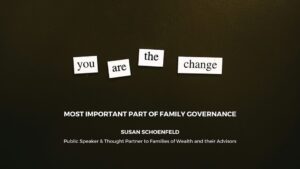
Please read this short piece discussing The most important part of family governance, as published in Point of View online magazine on December 7, 2024, also a short video clip.
 

Most important part of family governance

Last updated: July 7, 2026

The most important piece of advice I can offer on the topic of involving the next generation in the family governance exercise is this: As your family embarks on developing its governance structure, whether using facilitated family meetings or creating a governance document or engaging in a values exercise, the most important aspect is to make sure there is a mechanism built-in for changing the structure in the future. Provide for a required review every so many years to allow the opportunity for future generations to amend the structure in a way that makes sense for them, that perhaps the founding generation didn’t, or couldn’t possibly, foresee.

It’s all about multi-directional communication; it’s not just about the senior generation dictating the family’s values, but rather having the entire family gather and talk. Every family member should have the opportunity to have input into: Who are we as a family? How are we going to make decisions as a family? What process will we use to make the difficult decisions when we are not all in agreement?

The notion of continual review and renewal does not mean that you necessarily have to make it easy to amend your governance structure, just like the U.S. Constitution is hardly easy to amend, but there should be a democratic process in place for the family to make changes going forward such as they decide are necessary and appropriate.

I worked with a family a number of years ago who had inherited a very large family business from their parents. At the time I was invited into the family system, the parents had already passed away and the siblings co-owned the company. The professional management of the business determined that there was a need for outside capital, but there was no mechanism for that. Ultimately, the family business asked that each shareholder commit to keep their capital invested in the business for a lengthy term of years, in order to assure the continuity of the family business.

One of the siblings was not willing to tie up substantially all of their assets in an illiquid investment for the foreseeable future. At the beginning of the process, I asked each of the family members what the ideal outcome might look like. They all responded that they were still a family, and so for them, the ideal outcome was still being able to get together for holiday dinners. With that goal in mind, we started a series of family meetings to find common ground and build consensus.

It turned out that the family had, after quite a number of extensively negotiated amendments, an existing shareholders’ agreement that was accepted and respected by the family. Together we developed a new mutually agreeable amendment containing a mechanism for the corporation to redeem any shareholder in a way that everyone felt was fair, or at least equitable. Ultimately, using that new redemption mechanism in the amendment, that sibling had their shares redeemed by the company, freeing them to be a family member without the stress of being a co-shareholder.

A governance framework is not a “set it and forget it” endeavor. The flexibility to change your family’s governance structure as circumstances change and evolve in the future is the most important and forward-thinking part of the entire process.

Click to read this short thought piece on 3 Keys to Raising Families in an Atmosphere of Wealth, as published in Talking Trends online magazine on November 5, 2024.

You can also watch this brief video clip.

I am excited that this article was selected to be featured in the Fall 2024 edition of the Signitt Gazett, a semiannual publication that highlights thought-provoking articles and captivating interviews. https://www.signitt.net/gazett



3 Keys to Raising Families in an Atmosphere of Wealth

Last updated: July 7, 2026

The main takeaway that I would like to leave with everyone is the importance of communicating with your family members about the important topics of your family’s values, culture and legacy, and listening to your children and grandchildren communicating with you about their questions, concerns, and points of view.

My favorite quote on the topic of communication comes from George Bernard Shaw, who said that “The single biggest problem in communication is the illusion that it has taken place.” Very often we think that we have communicated much more than we actually have, and sometimes we have communicated a whole lot less than we have. It is important to communicate thoughtfully and intentionally to avoid misunderstandings.

The biggest mistake that I see is when parents tell me, my kids have no idea that we’re wealthy. Well, you know what? There’s a thing out there called the Internet. Your kids know how to use it. They Zillow your home. I had a client who told me that her daughter Zillowed their house, and then she also looked up the house of one of her private school schoolmates, and found out that her friend’s home was a lot more valuable. I responded that this was an opportunity for a teachable moment.

My three keys to raising kids in an atmosphere of wealth are number one, Start While Young. It is important to be consistent throughout your child’s lifetime in the messages you share, and it is never too early to start building that culture of age-appropriate communication.

Number two is Model the Behavior you want them to emulate, because kids will pay attention to what you do far more than they ever will to what you say.

And my third key to raising kids in an atmosphere of wealth is Find Teachable Moments. And the hint there is that teachable moments always come up at the most inconvenient times, so be ready when they occur.

Speaker on “Family Governance and The Single Family Office: Planning for the Next Generation” at the Opal Family Office & Private Wealth Management Forum West 2024, in Napa, CA.

“Susan nails it every time! She first spoke at Opal’s Annual Family Office & Private Wealth Management Forum back in 2014, and we’ve invited her back to speak every year since. Our audiences love her insight and actionable takeaways, and our in-house event planners love her flexibility and responsiveness.”

 — Doug Borths, (former) SVP & Head of Production, Opal Group


“Susan Schoenfeld delivered an insightful and engaging talk to some of our firm’s top clients, focusing on family governance and strategies for growing a lasting family legacy. Her professionalism, depth of knowledge, and warm presence made her a joy to work with, and her message truly resonated with our audience.”

— Michael D. Napier, CFP®, Managing Partner, HORAN Wealth, Cincinnati, OH


“Susan Schoenfeld is a gifted storyteller who blends expertise, experience, and insight in a way that draws people in—and moves them forward. Her keynote at our recent event for affluent families and business owners was met with universal appreciation from clients, our internal team, and outside experts alike. Susan has a rare ability to make complex topics feel clear, relevant, and actionable. Thanks to her contribution, our event was elevated and made more valuable for everyone in the room. She brought the same clarity and impact when speaking to one of our city’s most respected philanthropic organizations.”

— Mike Taylor, Founder & Chief Strategist, Mike Taylor Consulting


“Susan connected immediately with a diverse audience and held them rapt for the entire presentation. Her points were well supported, not just with data (over which she showed her mastery), but also with real-world, first-person experiences from her personal and professional background. Also importantly, she was a world-class person with whom to work. Our team loved getting to know her and were genuinely delighted at how friendly and pragmatic she was. She’s permanently on our short list of future speakers!”

— Michael M. Godsy, General Counsel & Director of Operations, LionsGate Advisors, St. Louis, MO


“We were honored to have Susan as a keynote speaker at our professional advisor seminar. Her presentation was exceptionally well-received. Susan’s insights resonated deeply with professionals across various disciplines, including attorneys, financial advisors, CPAs, and wealth planners.

Attendees were not only impressed by the rich content but also captivated by Susan’s skillful integration of storytelling and practical exercises. These elements effectively underscored key concepts and provided actionable advice for implementation in their respective practices.

Due to the overwhelming positive feedback, we are enthusiastic about inviting Susan back to address other targeted groups. Without hesitation, I highly recommend considering her as a speaker for your upcoming event or conference. You will undoubtedly find her expertise and delivery both insightful and engaging.”

— Gary Garcia, Vice President of Philanthropic Partnerships, The Dallas Foundation, Dallas TX


“Susan spoke to our network of professional advisors about the importance of the ‘soft’ topics when discussing family wealth. Her message hit home with our group, and it helped facilitate some amazing conversation about charitable giving within families of wealth. Her presentation was precise, thoughtful, and provided some amazing takeaways for our network of advisors. We absolutely loved working with Susan and would recommend her to anyone looking for a knowledgeable speaker!”

— Halee Cunningham, General Counsel/Director of Planned Giving, Blue Grass Community Foundation, Lexington KY


“As an advisor who deals with money behavior issues each and every day, it was great to have Susan speak at a recent client event of mine. Not only is she articulate and to the point with her message but she really shares a unique angle of openness to the fragile topic of Family ‘money talks.’”

— Christopher Cobb, Senior Vice President – Investments, Wells Fargo Advisors


“Susan spoke at our annual conference, and we invited her back to speak at our regional summer conference. An accomplished speaker, Susan addresses the topics foremost in the minds of family enterprise owners and stakeholders, as well as the attorneys and others who serve them. Her organization and responsiveness from planning through follow-up make her a pleasure to work with.”

— Andrew N. Karlen, Esq., (former) President, Attorneys for Family-Held Enterprises


“Susan is amazing! She was the coolest person at the conference.”

— Peter B. Zwack, Brigadier General U.S. Army (retired), Senior Russia-Eurasia Fellow, National Defense University


“Thank you so much for speaking for our group this morning. It was a fantastic event and I received excellent reviews from audience members so wanted to thank you again.”

–Eva Minsteris, CPA, Senior Managing Director, JSB Partners


“Thank you Susan for your fantastic talk at our Marcum Wealth Dimensions meeting. Your insights are spot-on, and the audience just loved it. Everyone was completely engaged.“

–Rorrie Gregorio CPA, Partner and Family Office Practice Leader, Marcum LLP

Read this short piece discussing the importance of Best Governance Practices for Family Offices, as published in Inspiration and Insights online magazine on October 10, 2024, also a brief video clip.


Best Governance Practices for Family Offices

Last updated: July 7, 2026

We can all learn from best practices for families and family offices.

The very best practice for a family is to plan ahead for leadership succession, starting on Day 1. Those families and family offices who think about and plan for their leadership succession from the very beginning are setting themselves up for success.

My second suggested best practice for families of wealth and family offices is a culture of open communication. The family should discuss and identify who they are as a family, what they stand for, not just their value statement, but actually their family story. I often help families craft their family story in such a way that it can be told and retold, not haphazardly, but intentionally and thoughtfully after consideration.

Kids love hearing bedtime stories and they all want to understand their place in the world. Establishing the narrative of how your family’s wealth was created, and telling it in a way that is repeatable and consistent, so that both the rising generations and incoming members of the family by marriage understand where they fit into the ecosystem, is assuredly a best practice.

The worst practice in a family is the fear of sharing information with the next generations. The end result is often the alienation of future members of the family, which might produce any number of undesirable outcomes. One is Inheritors Guilt: “I didn’t do anything to deserve this money, I’m just going to give it away.” One can only imagine the wealth creator rolling over in his grave, because he worked so hard and sacrificed so much to create the family wealth, and the last thing he likely would have wanted was to have it given away by a descendant who didn’t identify with the family’s culture, values and story.

The other extreme is the inheritor who basically says, “I’m just going to spend it on mansions and Maserati’s and other extravagances,” and isn’t thoughtful about stewardship for the benefit of future generations.

At the end of the day, my worst practice is the failure to communicate sensitive family information in an age-appropriate way. No one would suggest telling a six-year-old the details of your family balance sheet, because they don’t have the maturity or the perspective to understand that information.

Nevertheless, there are many age-appropriate ways to start investing in your next generation and engaging them. You might consider establishing a Junior Advisory Council where they are invited to the family board meetings; maybe they don’t have a vote, but they have a voice, and they get to listen and learn and become part of the family’s governance practices.

My suggested best practices for families and family offices include a culture of open communication and a focus on leadership succession planning.

Speaking for the Community Foundation of Greater Birmingham at their Donors event on the evening of Thursday, Sept. 26, and their Professional Advisors event on the morning of Friday, Sept. 27.