
Please read this short piece on Mother Knows Best, published in Point of View online magazine on August 4, also a short video clip.
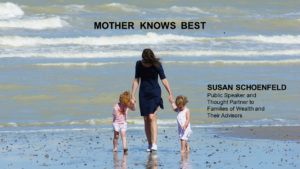
Susan explains why she often begins family governance work with the matriarch — the person who typically carries the family’s real relational history — and why that institutional knowledge, not just the balance sheet, determines whether wealth becomes a source of stability or division.
Last updated: August 4, 2026
I’ve worked with wealthy families for my entire career, and I have noticed patterns that repeat, regardless of geography, culture, or net worth.
Here’s one that has never really changed. It’s almost always the mother, or the grandmother, who carries the family’s real history, the parts nobody puts in writing. She’s the one who remembers that her son never got over the way his sister’s graduate school was funded while he was expected to figure it out himself. She knows that her daughter-in-law still feels like an outsider every Thanksgiving, even though everyone insists that everything is “fine.” She remembers which cousins haven’t spoken in three years and, more importantly, why no one ever talks about it anymore.
None of those things appear on a balance sheet. Yet those invisible relationships often determine whether a family’s wealth becomes a source of stability or a catalyst for division.
That is why, when I’m invited into a family to talk about legacy, governance, or preparing the next generation, I usually ask to begin with the matriarch.
The matriarch carries what no one writes down
I want to be careful here, because this isn’t about stereotypes or overgeneralizations. It’s about a pattern I’ve seen repeat itself across many families over many years. Women have long stitched the invisible threads of family life, tracking the dynamics that never make it into a quarterly report: whose marriage is under strain, whose ambition is going to collide with a sibling’s sense of what’s fair, and who is striving to finally feel seen or heard.
The matriarch usually holds the fullest picture of who the family actually is: not just the assets, but the people, and not just the structures, but the relationships those structures are supposed to protect. Much of my work involves helping her take everything she’s been carrying in her head for decades and translating it into something the entire family can understand, discuss, and eventually own together.
Family governance planning starts with people, not money
Family governance planning is the work of putting a family’s shared values and decision-making principles into a form the whole family can actually use: a mission statement, a values statement, or in more complex cases, a full family constitution. It’s different from estate planning, which is about who gets what. Governance planning is about who you are as a family, and how you’re going to make decisions when things get hard, because they inevitably will.
What family governance actually looks like in practice
Some families start small: one family I worked with began with a single paragraph on what they stood for and why. Other families get more granular, building out a full values statement with specifics about education, philanthropy, entrepreneurship, stewardship, work ethic, financial responsibility, and service. And some families, usually the ones running an operating business together, go all the way to a family constitution: a governing document that spells out how new members are welcomed in, how disagreements get resolved, and how decisions about shared assets actually get made.
I always tell families the same thing about these documents: They are not built to be legally enforced; they’re built to be remembered and respected. Their power comes from the process of writing them, from finally having those conversations that most families have postponed for years. They create clarity around expectations before conflict arrives, and they give everyone something to return to when emotions inevitably run high.
Governance planning has to happen while everyone’s still getting along
There’s another pattern I’ve seen far too many times. Families wait until siblings have stopped speaking, until litigation becomes a possibility, until someone dies unexpectedly, or until resentment has had years to harden into certainty. Only then do they call someone like me. By that point, every conversation is more difficult and considerably more expensive than it needed to be.
The healthiest governance work happens while everyone still enjoys being together, while holiday dinners and family vacations are still something people look forward to, and while the grandchildren are still learning the family’s stories instead of inheriting its conflicts.
Every marriage brings someone new into the family system, and every new generation brings its own expectations about money, responsibility, communication, and identity. Over time, cousins who once played together become adults who barely know one another.
Without intentional work, the only thing connecting them may be a shared last name and perhaps a trust agreement. That’s a thin thread to hold a family together.
Families who invest in governance create something much stronger. They build a shared identity that can outlast the people who originally created it.
The key takeaway:
If there’s one thing I’d want a family, or their attorney or wealth advisor, to take from this, it’s that the matriarch isn’t a side character in this process. She’s usually the architect. She’s carrying the institutional knowledge of the family’s relationships, and the real work is helping her translate that into something durable that the whole family can own into the future, after she’s no longer the one holding it together.
I’ve watched families do this well, and I’ve watched families put it off until it was too late. The families who begin early protect more than just their wealth. They protect something far more difficult to rebuild once it’s been lost: they protect their shared understanding of who they are, why their wealth exists, and what they hope it will accomplish for generations to come.
A few questions people ask me:
Is a family constitution actually a legal document? No. A family constitution isn’t designed for a courtroom; it’s designed for a family room. Its value comes from the conversations that created it and the shared commitment to keep returning to it when life gets complicated.
What if the matriarch isn’t the one who wants to do this work? That’s perfectly fine. The point isn’t that it has to be the mother or grandmother every single time. It’s that someone usually holds the family’s relational history and understands the emotional landscape. My job is to find that person and help turn what they’ve been carrying into something everyone can share. More often than not, that person happens to be the matriarch, but not always.
How long does something like this take? Longer than most people expect, and I actually see that as a good sign. If a family constitution is finished in an afternoon, I’d wonder whether anyone had the conversations that really mattered. The final document is important, but it’s almost a byproduct. The real deliverable is the dialogue that happens along the way.